Lesson 8.2: ECDSA Private Key Recovery from Nonce Reuse
ECDSA is strong, but all of its security hangs on one thing. The nonce k must be random, secret, and different on every signature. If two different messages are signed with the same k, or if two signatures merely happen to share k, an attacker solves for k and then for the private key d. This flaw has broken the PlayStation 3 and several Bitcoin wallets. This lesson gives you the formula, a demo that runs on a small curve, and a lab that recovers a real private key on secp256k1.
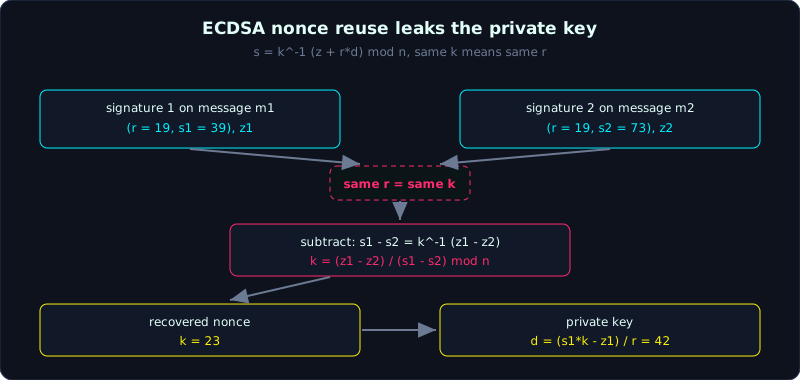 Two signatures with the same r share the nonce k. Subtracting the two s values gives k, and k gives d.
Prerequisites: Lesson 8.1 (ECC, ECDSA signing and verifying), Lesson 1.1 (modular inverse). You should be comfortable with the formula s = k^(-1)(z + r*d).
Tools: Python 3 + PyCryptodome (for the AES decryption in the lab). Install with pip install pycryptodome. The solved lab is described in the Lab section below.
Goals
You will see why reusing the nonce k leaks k and then the private key d, and derive the formula. You will spot nonce reuse just by looking at two signatures, where r is the same. You will code the recovery of d from two signatures with the same k, running on a small curve. And you will recover a real private key on secp256k1 in the lab and decrypt the flag.
Theory
Why nonce reuse breaks ECDSA
Recall the signing formula from Lesson 8.1. With hash z, nonce k, and r = (k*G).x mod n, the signature is (r, s) with
1
s = k^(-1) * (z + r*d)  mod n
Now sign two different messages (hashes z1, z2) with the same k. Since r depends only on k*G, the same k gives the same r. The two signatures are:
1
2
s1 = k^(-1) * (z1 + r*d)  mod n
s2 = k^(-1) * (z2 + r*d)  mod n
Subtract the two: s1 - s2 = k^(-1) * (z1 - z2) mod n. Only one unknown k remains, and it solves directly:
1
k = (z1 - z2) * (s1 - s2)^(-1)  mod n
With k known, substitute into the first equation to get d:
1
d = (s1*k - z1) * r^(-1)  mod n
All of this is arithmetic mod n, with no curve operation at all. The flaw is in how k is generated, but the consequence is permanent loss of the signing key.
How to recognize it
The clearest sign is two signatures on different messages that have the same r. Since r = (k*G).x mod n, a repeated r almost certainly means a repeated k (the chance of a random collision is 1/n, which is tiny). In a CTF, a set of signatures where two share r should make you think of this attack at once. In real systems the flaw usually comes from a bad RNG (a wrongly deterministic k), cloned virtual machines that restore the same RNG state, or a programmer hardcoding k for convenience.
Variants
Nonce bugs are not only about reuse. If k is biased, for example the top few bits are always 0, then collecting many signatures and building a lattice (HNP, the hidden number problem) also extracts d, but it needs tools like Sage and LLL, which are outside this lesson. If k is small or predictable (a weak RNG), guess k and apply the formula above with a single signature. This lesson focuses on reuse because it is simple, can be done by hand, and is the most common.
Demo
Recovering the private key on a small curve
We reuse the curve from Lesson 8.1 (p = 97, a = 3, b = 2, G = (0, 14), n = 103) with private key d = 42. We sign two different messages with the same k = 23 and then break it.
1
2
3
4
5
6
7
8
9
10
11
12
13
14
15
16
17
18
19
20
21
22
23
24
25
26
27
28
29
30
31
32
33
34
35
36
37
38
39
40
41
42
43
44
45
46
47
48
49
50
51
52
53
54
55
56
57
# d82_demo.py: ECDSA leaks the private key when nonce k is reused (on the small curve from Lesson 8.1)
import hashlib

p, a, b = 97, 3, 2
INF = None
G = (0, 14)
n = 103

def point_add(P, Q):
    if P is INF: return Q
    if Q is INF: return P
    x1, y1 = P; x2, y2 = Q
    if x1 == x2 and (y1 + y2) % p == 0: return INF
    if P == Q:
        m = (3 * x1 * x1 + a) * pow(2 * y1, -1, p) % p
    else:
        m = (y2 - y1) * pow(x2 - x1, -1, p) % p
    x3 = (m * m - x1 - x2) % p
    y3 = (m * (x1 - x3) - y1) % p
    return (x3, y3)

def scalar_mul(k, P):
    R = INF; Q = P
    while k > 0:
        if k & 1: R = point_add(R, Q)
        Q = point_add(Q, Q); k >>= 1
    return R

def H(msg):
    return int.from_bytes(hashlib.sha256(msg).digest(), "big") % n

d = 42                       # secret signing key (the recovery target)
Q = scalar_mul(d, G)

def sign(msg, k):
    z = H(msg)
    r = scalar_mul(k, G)[0] % n
    s = (pow(k, -1, n) * (z + r * d)) % n
    return (r, s)

# --- sign TWO different messages with the SAME k (fatal mistake) ---
k = 23
m1, m2 = b"send 10 BTC to Alice", b"send 20 BTC to Bob"
r1, s1 = sign(m1, k)
r2, s2 = sign(m2, k)
print("signature 1: r =", r1, "s =", s1)
print("signature 2: r =", r2, "s =", s2)
print("r equal?", r1 == r2, "  <- sign of nonce reuse")

# --- attack: from two signatures with the same r, solve for k and then d ---
z1, z2 = H(m1), H(m2)
r = r1
k_rec = (z1 - z2) * pow(s1 - s2, -1, n) % n       # k = (z1 - z2) / (s1 - s2)
d_rec = (s1 * k_rec - z1) * pow(r, -1, n) % n     # d = (s1*k - z1) / r
print("recovered k =", k_rec, "(real:", k, ")")
print("recovered d =", d_rec, "(real:", d, ")")
print("correct?", d_rec == d and scalar_mul(d_rec, G) == Q)
Output:
1
2
3
4
5
6
signature 1: r = 19 s = 39
signature 2: r = 19 s = 73
r equal? True   <- sign of nonce reuse
recovered k = 23 (real: 23 )
recovered d = 42 (real: 42 )
correct? True
The two signatures have the same r = 19 even though the messages differ, and that is the red flag. From there the formula pulls out k = 23 and then d = 42, exactly the private key, and checking d*G == Q confirms it. The ECDLP is never touched, only a few modular divisions mod n.
The solved lab on secp256k1
The Lab section below has the real version. It has two ECDSA signatures on secp256k1 (the Bitcoin curve) that share the same nonce, plus a flag encrypted with AES-GCM under a key derived from the private key. solve.py is self-contained, applies exactly the formula above to recover the 256-bit d, and decrypts the real flag. The formula is identical to the small demo, only n is the secp256k1 group order.
Lab
- Task: secp256k1, two messages
m1,m2with signatures(r, s1)and(r, s2)that sharer, and one AES-GCM ciphertext with a tag. The AES key issha256(str(d)). Recoverdand decrypt the flagECC{...}. - Files:
solve.py,README.md,transcript.txt. - Hints in steps: (1) compute
z1 = sha256(m1) mod n, andz2the same way; (2)k = (z1 - z2) * inverse(s1 - s2, n) mod n; (3)d = (s1*k - z1) * inverse(r, n) mod n; (4)key = sha256(str(d).encode()).digest()thenAES.new(key, AES.MODE_GCM, nonce=...).decrypt_and_verify(ct, tag). - Extension: write a function that scans a list of signatures, finds the pair with the same
rby itself, then applies the attack. This is the realistic scenario when you hold many signatures from a service. - Done when you get the correct private key
d(checkd*G == Q) and decrypt the flagECC{...}.
Key takeaways
- Two signatures on different messages with the same
rmean the same noncek. That is the only sign you need to look for. k = (z1 - z2) / (s1 - s2) mod n, thend = (s1*k - z1) / r mod n. All arithmetic is modn.- Leaking the
kof a single signature is also enough to getd:d = (s*k - z) / r mod n. - Defense: generate
kdeterministically following RFC 6979 (fromdand the message), or use Ed25519 (deterministic nonces are part of its design). - Nonce bugs are not only reuse. A nonce biased by a few bits can also be broken with a lattice (HNP), but that needs Sage.
Common pitfalls
- Forgetting to reduce the hash mod
n. Thezin ECDSA is the hash truncated and reduced into[0, n). Using the raw hash without reducing it skews the formula and gives a wrongd. - Mixing
mod pwithmod n. Every operation in this attack is by the group ordern, not the field primep. Using the wrong modulus breaks it. - Assuming a repeated
ris enough with different signers. This lesson assumes the same signer. If two signatures sharerbut come from different signers, the attack does not apply (rare, and not meaningful in practice). - The minus sign when computing
s1 - s2can give a negative number. Python handlespow(x, -1, n)for negative numbers through the modulus, but if you write your own inverse, bring the value into[0, n)first. - Thinking ECDSA being secure means you can ignore the nonce. The nonce is the weakest part. Pick Ed25519 or RFC 6979 so you do not have to generate
kyourself.
Further reading
- fail0verflow, the talk on the PS3 (reused ECDSA nonces exposed Sony’s firmware signing key), a classic real-world example.
- RFC 6979, Deterministic ECDSA, a safe way to generate
kdeterministically from the key and the message. - CryptoHack, the “Elliptic Curves” group, the ECDSA and nonce challenges, and the hidden number problem challenges if you want to try lattices.
- Nguyen, Shparlinski, “The Insecurity of the Elliptic Curve DSA with Partially Known Nonces”, the theory behind the biased nonce attack.