Lesson 0.2: Legal and ethical ground rules
Lesson 0.2: Legal and ethical ground rules
This is the least exciting part of the series, but skipping it can cost you a banned account, money, or legal trouble. Read it once and keep it in mind.
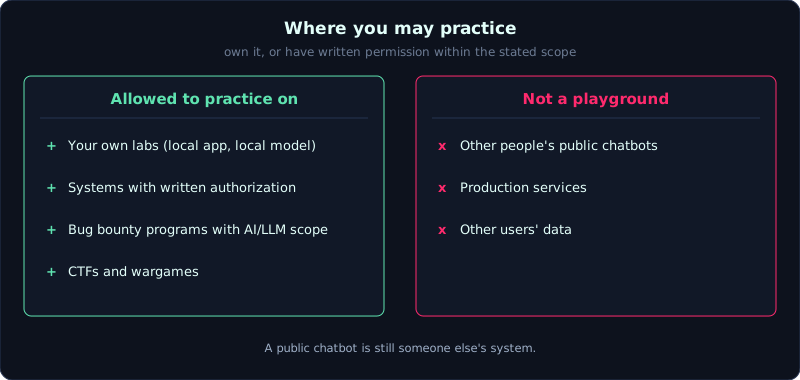 Systems you may practice on, and systems you may not.
The boundary in one sentence
You may only attack systems you own, or systems whose owner has given you written permission, within the scope that document states. There is no exception for “just trying it for fun”.
Why LLMs make it easy to cross the line
Public chatbots are everywhere, and “attacking” one takes a few typed sentences, so it feels harmless. It is not:
- Sending an exploit payload to a company’s chatbot is unauthorized access under the laws of many countries (in Vietnam, the cybercrime articles of the Criminal Code; in the US, the CFAA, and so on).
- Using unbounded consumption techniques (Lesson 8) against a real service is a denial-of-service attack and causes real financial damage to the owner.
- Extracting other users’ data through a vulnerability is a personal data violation (in Vietnam, Decree 13/2023 on personal data protection).
Where you are allowed to practice
- Your own labs. The whole series uses these. The app runs locally, the model runs locally, and nobody else is affected.
- Your organization’s systems, when you have written red team authorization that states the scope and the time window.
- Bug bounty programs with AI/LLM terms. Read the scope carefully. Many programs exclude “model safety/jailbreak” and accept only application vulnerabilities (for example, output handling that leads to a real XSS).
- CTFs and wargames built for this purpose.
Responsible red teaming
If you red team an LLM system legally:
- Stay in scope. Touch only the accounts, data, and endpoints listed in the scope.
- Minimize real data. When you prove a data leak, take one sample that is enough to show the problem, then stop. Do not collect everything.
- Do not break the service. Test unbounded consumption on staging, or at an agreed rate, and never hammer production.
- Report responsibly (coordinated disclosure). Send the report privately to the vendor and give them time to patch before publishing. Do not post a 0-day payload together with the victim’s name.
Ethics of publishing payloads
This series describes payloads. When you write your own blog posts or training material:
- Demonstrate on your own lab and remove details that identify a real system.
- Describe the vulnerability class and the fix, not only a payload string for others to copy and misuse.
- Consider the harm. A jailbreak that makes a model swear is very different from a technique that makes an agent delete customer data.
Key takeaways
- Attack only your own systems, or systems you have written permission for, within the stated scope.
- A public chatbot is still someone else’s system, so it is not a place to practice.
- A local lab is a safe place to try any payload.
- Red team rules: stay in scope, minimize real data, do not disrupt the service, and disclose responsibly.
This post is licensed under CC BY 4.0 by the author.