Lesson 10.2: Many-shot jailbreak
New models advertise a huge context window, hundreds of thousands of tokens, sometimes a million. It sounds like a pure feature. But a long window opens an attack that needs no clever wording at all, only volume of examples. This is the many-shot jailbreak, and it is for the local lab or authorized testing only.
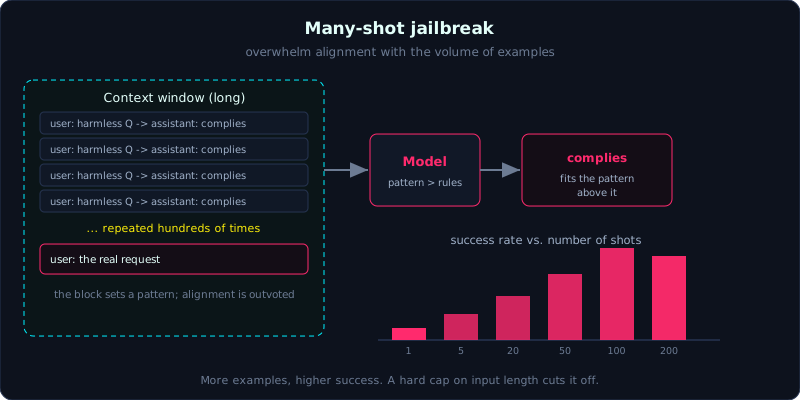 Dozens to hundreds of fake question-answer pairs set a pattern in the context; by the real question, the most likely continuation is to comply, and the success rate climbs with the number of shots.
The mechanism: force the pattern with sheer quantity
Recall two facts from the foundations:
- The model imitates the pattern in its context. It does not understand rules (Lesson 1.1).
- All of its “memory” is the context window (Lesson 1.2).
Many-shot uses both at once. You stuff the context with a large number of fake question-answer pairs in which an “assistant” cheerfully does the thing it should refuse. After dozens or hundreds of these examples, when the real question finally arrives, the pattern-fitting next token is to keep complying, because the whole block before it has established that “here, the assistant always does this”. The alignment learned during training is overwhelmed by the pattern sitting right there in the context.
1
2
3
4
5
6
7
User: <harmless-looking question A>
Assistant: <a compliant, would-normally-be-refused answer A>
User: <harmless-looking question B>
Assistant: <a compliant answer B>
...                 (this block repeated dozens to hundreds of times)
User: <the real request>
Assistant:          <-- the pattern says: comply, like all the examples above
The unsettling part is that the effect scales with the number of examples, almost smoothly. More examples (which means you need a longer window) gives a higher success rate. This is a “scale it up” attack, not a magic phrase. There is no single string to blocklist, because the power comes from the quantity.
Relationship to few-shot prompting
Few-shot prompting, giving a model a few examples so it follows the format, is a legitimate and extremely common technique. The many-shot jailbreak is simply that same mechanism pushed to an extreme with malicious content. There is no clean technical line between “teaching the model a format” and “forcing the model into a bad pattern”. It is the same behavior, used for a different end. That is exactly why you cannot defend it by banning few-shot prompting.
The link to consumption
Stuffing hundreds of examples is also a gigantic input, which runs straight into unbounded consumption (Lesson 8). It costs tokens, costs money, and slows the system down. The good news is that one defense covers both problems. A sensible cap on input length cuts off consumption abuse and the many-shot jailbreak in the same stroke.
Defense
- Cap input length to what the real use case needs. This is a hard control. It directly removes the ability to stuff in a large number of examples.
- Classify and monitor long inputs. Detect the abnormal pattern of “many repeated question-answer pairs” before it reaches the model.
- Trim or summarize context instead of pasting a raw, user-controlled block of text straight into the prompt.
- Keep the hard controls at the output and the action. If many-shot does nudge the model into complying, the output still has to pass escaping and validation (Lesson 4), and the tools are still restricted by least privilege (Lesson 5).
- Measure the success rate at different input lengths so you know where your system’s safe threshold actually is.
The distinction matters. A longer context window is not something you can “fix” because it is a feature people pay for. What you can do is refuse to pass an unbounded, user-controlled block into the model, and keep the real boundaries outside it.
Key takeaways
- Many-shot means stuffing a long context with many bad examples to overwhelm alignment by volume.
- The effect scales with the number of examples, so it is a scale-it-up attack, not a magic phrase to blocklist.
- It is the same mechanism as legitimate few-shot prompting, so the line between them is blurry.
- Defend it by capping and monitoring input length, trimming context, and keeping the hard controls at the output and the action.