Adworld Reversing 2022: writeups

This is not a dated competition. It is a practice set of reverse engineering challenges from the Adworld platform that I worked through in 2022, using IDA, static analysis and small C++ or Python scripts to invert the checks. The set has around 52 challenges. This post covers the ones I solved, grouped by technique: byte-wise XOR and arithmetic decoders, strided and table-based decoders, reproducing logic from source or threads, runtime-decoded code, and unpacking. Everything here is static analysis, I did not run the binaries as part of the writeups.
XOR and arithmetic decoders
Rev - 666
Files: 666.zip
The binary compares the input against an encoded string. The encoder works on groups of three bytes with a key of 18, and each byte of the group gets a different operation. Because every step is invertible, I applied the inverse to the stored string izwhroz""w"v.K".Ni.
1
2
3
4
5
6
7
8
9
10
11
string encode(){
    char a2[100] = "izwhroz\"\"w\"v.K\".Ni";
    char flag[100];
    int key = 18;
    for (int i = 0; i < key; i += 3 ){
        flag[i] = (key ^ *(char *)(a2 + i)) - 6;
        flag[i + 1] = (*(char *)(a2 + i + 1LL)  ^ key) + 6;
        flag[i + 2] = *(char *)(a2 + i + 2LL) ^ 6 ^ key;
    }
    return flag;
}
Flag: unctf{b66_6b6_66b}
Rev - xxxorrr
Files: xxxorrr.zip
The program XORs a constant string with 2 * i + 65 for each index, and then XORs the result with a stored byte array. Running the same two operations on the constant string produces the flag, since XOR is its own inverse.
1
2
3
4
5
6
7
8
9
10
11
12
13
14
15
unsigned char s2[] =
{
0x56, 0x4E, 0x57, 0x58, 0x51, 0x51, 0x09, 0x46, 0x17, 0x46,
0x54, 0x5A, 0x59, 0x59, 0x1F, 0x48, 0x32, 0x5B, 0x6B, 0x7C,
0x75, 0x6E, 0x7E, 0x6E, 0x2F, 0x77, 0x4F, 0x7A, 0x71, 0x43,
0x2B, 0x26, 0x89, 0xFE, 0x00
};

char s1[] = "qasxcytgsasxcvrefghnrfghnjedfgbhn";
for (int i = 0; i <= 33; ++i )
    s1[i] ^= 2 * i + 65;
for(int i = 0; i < strlen(s1); i++){
    s1[i] = s1[i] ^ s2[i];
}
cout << s1;
Flag: flag{c0n5truct0r5_functi0n_in_41f}
Rev - IgniteMe
Files: igniteme.zip
The check XORs the input with a table, applies (x - 72) ^ 0x55, and then shifts the case of letters. I extracted the 32 byte table from IDA (export result), XORed it with the 24 byte constant GONDPHyGjPEKruv{{pj]X@rF, reversed the arithmetic, and then lowercased the uppercase letters to match the case shift. The EIS{...} wrapper is added around the result.
1
2
3
4
5
6
7
8
9
10
11
12
13
14
15
16
17
18
unsigned char ida_chars[] ={
    13,  19,  23,  17,   2,   1,  32,  29,  12,   2,
    25,  47,  23,  43,  36,  31,  30,  22,   9,  15,
    21,  39,  19,  38,  10,  47,  30,  26,  45,  12,
    34,   4
};
char flag[5] = {'E', 'I', 'S', '{', '}'};
char fl[100] = "";
char c[] = "GONDPHyGjPEKruv{{pj]X@rF";
for(int i = 0; i < 24; i++){
    fl[i] = c[i] ^ ida_chars[i];
    fl[i] = (fl[i] - 72) ^ 0x55;
}
for(int i = 0; i < 24; i++){
    if (fl[i] >= 'A' && fl[i] <= 'Z' )
        fl[i] += 32;
}
cout << flag[0] << flag[1] << flag[2] << flag[3] <<  fl << flag[4];
Flag: EIS{wadx_tdgk_aihc_ihkn_pjlm}
Rev - crypt
Files: crypt.zip
The binary XORs a 22 byte array with 0x22 before comparing. My sol.cpp applies that XOR to the array extracted from IDA.
1
2
3
4
5
6
7
char ida_chars[100] ={
158, 231,  48,  95, 167,   1, 166,  83,  89,  27,
10,  32, 241, 115, 209,  14, 171,   9, 132,  14,
141,  43};
for(int i = 0; i < strlen(ida_chars); i++)
    ida_chars[i] ^= 0x22;
cout << ida_chars;
Status: flag not recorded. When I applied only this XOR to the array, the output was not printable text, so this script is an intermediate step and there is no flag file for this challenge. I am not listing a flag for it.
Strided and table based decoders
Rev - Reversing-x64Elf-100
Files: reversing-x64elf-100.zip
The check builds 12 characters by reading from three strings in turn, taking every second character of each string, and subtracting 1. The index into the strings is 2 * (i / 3) and the string is chosen by i % 3.
1
2
3
4
5
6
v3[0] = (__int64)"Dufhbmf";
v3[1] = (__int64)"pG`imos";
v3[2] = (__int64)"ewUglpt";

for (i = 0; i <= 11; ++i)
     cout <<  char(*(char*)(v3[i % 3] + 2 * (i / 3)) - 1);
Flag: Code_Talkers
Rev - game
Files: game.zip
The flag is stored in the binary as two encoded arrays, and a third array of 57 bytes is used as a keystream. The first 22 bytes are XORed with the first 22 keystream bytes and with 0x13. The next 34 bytes continue through the keystream and are XORed the same way. I copied the arrays from the decompiler and ran the same loops.
1
2
3
4
5
6
7
8
9
10
11
12
13
int i;
for (i = 0; i < 22; ++i )
{
    v3[i] ^= v6[i];
    v3[i] ^= 0x13u;
}
for (int j = 0; j < 34; ++j )
{
    v4[j] ^= v6[i];
    v4[j] ^= 0x13u;
    i++;
}
cout << v3 << v4;
The full byte arrays are in the script, they are long so I only show the decoding loops here.
Flag: zsctf{T9is_tOpic_1s_v5ry_int7resting_b6t_others_are_n0t}
Rev - srm-50
Files: srm-50.zip
The program rebuilds a 26 character key in a buffer by assigning individual bytes (v11[0], v11[1], and so on). I reproduced the assignments in Python to see the key.
1
2
3
4
5
6
7
8
9
10
11
12
13
14
15
16
17
18
v11 = bytearray(b"XXXXXXXXXXXXXXXXXXXXXXXXXX")
v11[0] = ord("C")
v11[1] = ord("Z")
v11[2] = ord("9")
v11[3] = ord("d")
v11[4] = ord("m")
v11[5] = ord("q")
v11[6] = ord("4")
v11[7] = ord("c")
v11[9] = ord("g")
v11[10] = ord("9")
v11[11] = ord("G")
v11[12] = ord("7")
v11[13] = ord("b")
v11[14] = ord("A")
v11[15] = ord("X")
v11[8] = ord("8")
print(v11)
Status: the script only reconstructs the first 16 bytes of the key and I did not record a flag, so I am not giving one here.
Reproducing logic from source or from a thread
Rev - open-source
Files: open-source.zip
This one comes with C source. The program requires first == 0xcafe, a second value with second % 5 != 3 and second % 17 == 8, and the third argument must be h4cky0u. Then it prints a hash. I did not need a valid second beyond its modulus, because only second % 17 enters the hash and that is fixed to 8. Reproducing the formula gives the key. Using 25 as the second value satisfies the checks since 25 % 17 == 8 and 25 % 5 == 0.
1
2
3
4
5
6
int first = 0xcafe;
int second = 25;
char s[] = "h4cky0u";
unsigned int hash = first * 31337 + (second % 17) * 11 + strlen(s) - 1615810207;
printf("Get your key: ");
printf("%x\n", hash);
Flag: c0ffee
Rev - parallel-comparator-200
Files: parallel-comparator-200.zip
The program takes 20 characters and compares them in parallel threads. Each thread checks that one character equals a base letter plus a delta from a table. The base is a single lowercase letter shared by all positions, so I brute forced the 26 possible bases and applied the delta table to each. I also kept a small thread.c test program to confirm how pthread creates a thread that runs alongside the main one.
1
2
3
4
5
6
7
d = [0, 9, -9, -1, 13, -13, -4, -11, -9, -1, -7, 6, -13, 13, 3, 9, -13, -11, 6, -7]
for j in range(26):
    flag = ""
    for i in range(20):
        fl = (j % 26) + 97
        flag += chr(fl + d[i])
    print(flag)
Only one of the 26 lines is a readable phrase, the one using base letter l.
Flag: lucky_hacker_you_are
Runtime decoded code
Rev - BABYRE
Files: babyre.zip
The main function reads 14 bytes of input and calls judge(s). In IDA, judge showed up as an array of values and not as code. The call is written as (*(unsigned int (__fastcall **)(char *))judge)(input_flag), which means judge is data that is called as a function with a char * argument, returning unsigned int.
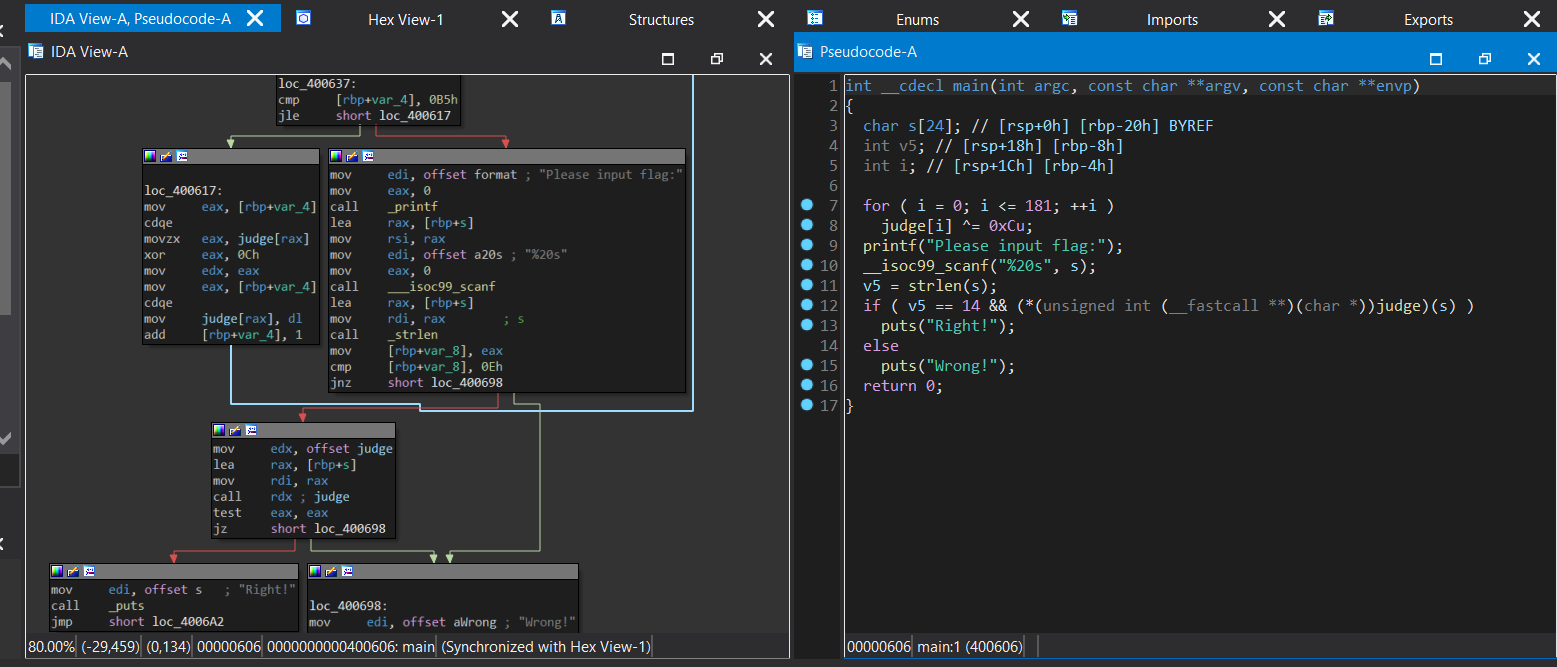
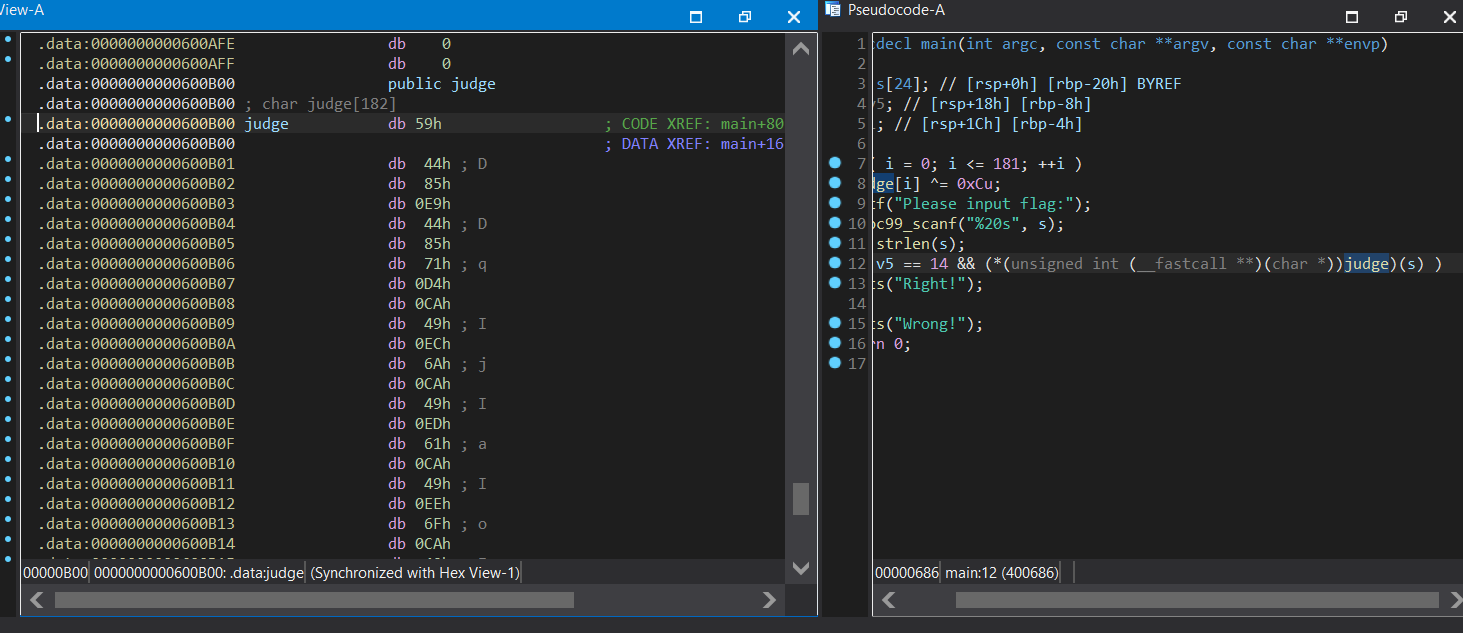
Before asking for the flag, the program decodes the bytes of judge() in place:
1
2
3
  for ( i = 0; i <= 181; ++i )
    judge[i] ^= 0xCu;
  printf("Please input flag:");
Since this happens at runtime, I patched the 182 bytes in the IDA database with an IDAPython script that applies the same XOR.
1
2
3
st = 0x600b00
for i in range(182):
    patch_byte(st + i, ord(get_bytes(st + i, 1))^0xC)
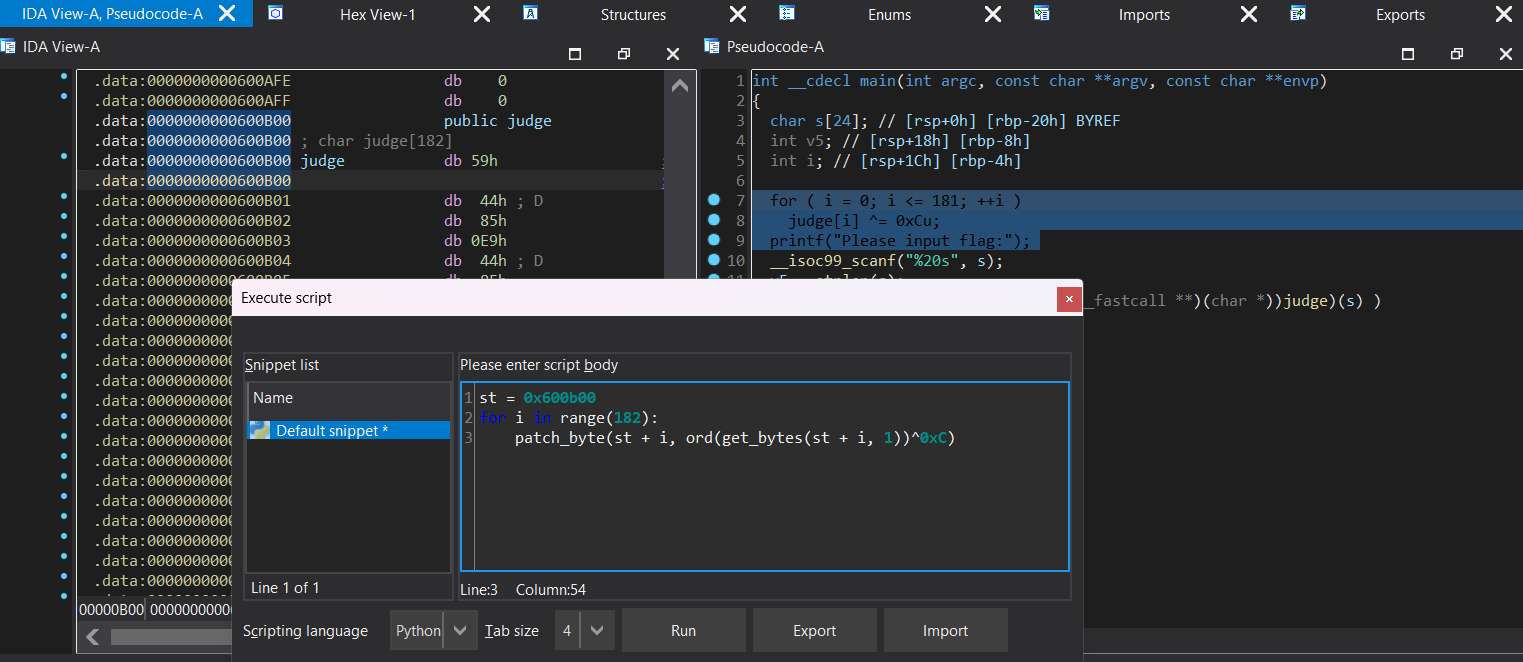
After patching, the original bytes are back. Pressing c turns them into code and pressing p makes a function out of them, so the decompiler can show the check.
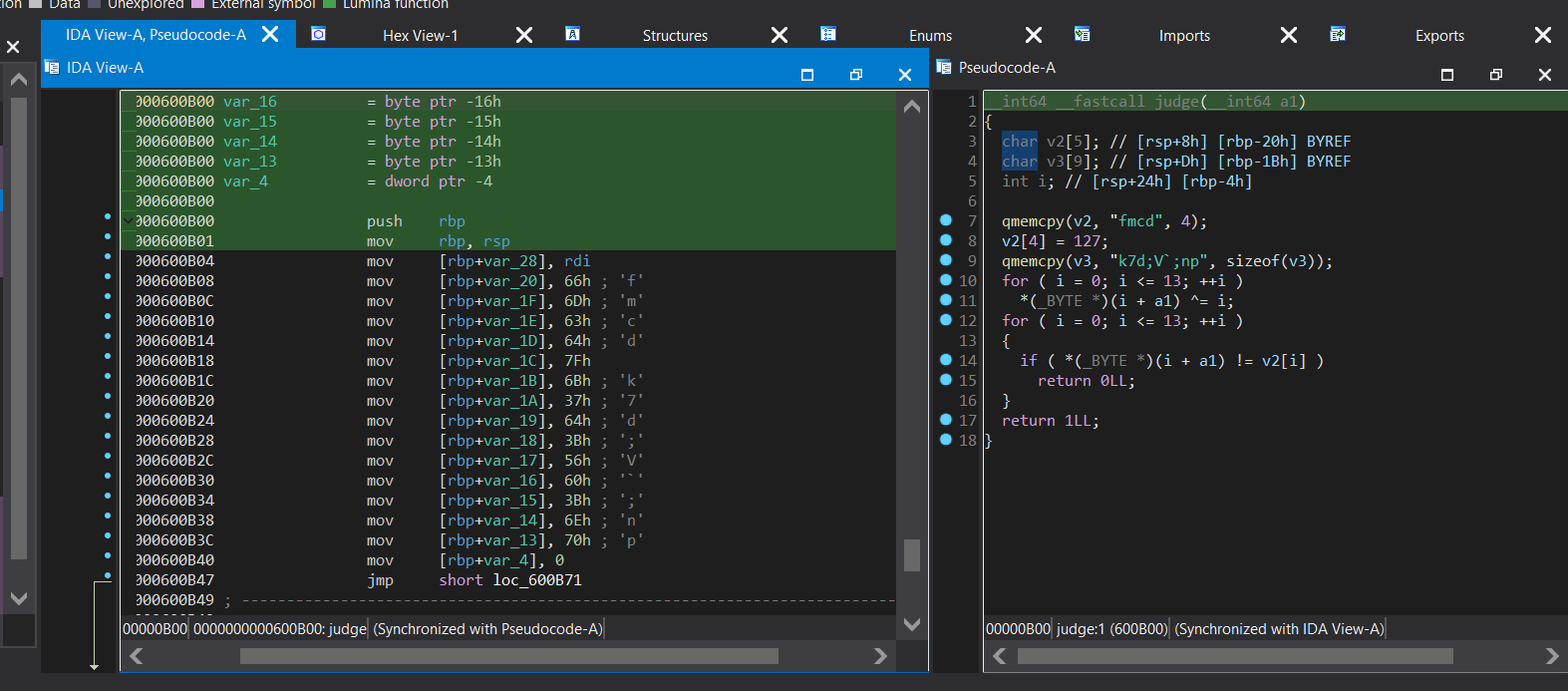
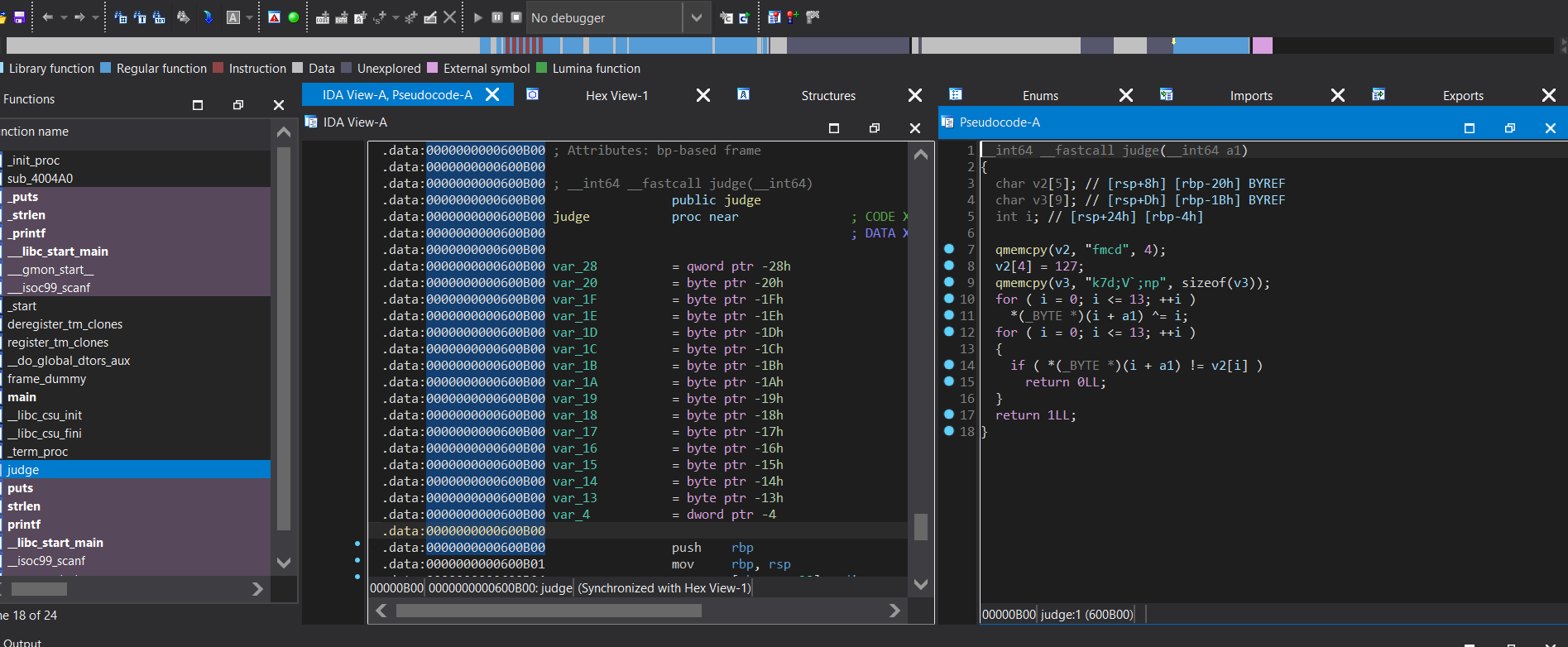
From there I reversed the check. The first five bytes are fmcd and 127, each XORed with its index. The rest is k7d;V;np`, XORed with a counter that continues from the previous loop.
1
2
3
4
5
6
7
8
9
10
11
12
13
14
15
char v2[100];
v2[0] = 'f';
v2[1] = 'm';
v2[2] = 'c';
v2[3] = 'd';
v2[4] = 127;
char v3[10] = "k7d;V`;np";
int i;
for (i = 0; i < strlen(v2); ++i )
    v2[i] ^= i;

for(int j = 0; j < strlen(v3); i++, j++)
    v3[j] ^= i;

cout << v2 << v3;
Two notes from my own mistakes on this one. First, I spent a long time on the call expression before understanding that judge is the function itself, built at runtime from data. Second, in IDA 7.5 the pointer was treated as plain data, so I had to press c and then p at the start of judge before the decompiler would work on it.
Flag: flag{n1c3_j0b}
Unpacking
Rev - simple-unpack
Files: simple-unpack.zip
The binary is packed with UPX. Running upx -d <file> restores the original executable, and the flag then shows up in the unpacked binary.
Flag: flag{Upx_1s_n0t_a_d3liv3r_c0mp4ny}
Solved without a recorded script
These four have a recorded flag but no solve script in my notes, so I only list the flag.
Rev - easyRE1
Files: easyre1.zip
Flag: flag{db2f62a36a018bce28e46d976e3f9864}
Rev - lucknum
Files: lucknum.zip
Flag: flag{c0ngr@tul@ti0n_f0r_luck_numb3r}
Rev - Shuffle
Files: shuffle.zip
Flag: SECCON{Welcome to the SECCON 2014 CTF!}
Rev - insanity
Files: insanity.zip
Flag: 9447{This_is_a_flag}
Static analysis and replay - getit
A 64-bit Linux ELF that builds a flag string and writes it into the file /tmp/flag.txt, then deletes the file.
The binary never prints the flag. It holds the 32 character string c61b68366edeb7bdce3c6820314b7498 at 0x6010a0 and a template SharifCTF{????...????} at 0x6010e0. The first loop sets buf[i+10] = s[i] + 1 when i is odd and s[i] - 1 when i is even. The second loop only shuffles the bytes into the file through a table of offsets and then removes the file, so the finished template is the flag.
1
2
3
4
5
s = b'c61b68366edeb7bdce3c6820314b7498'
b = bytearray(b'SharifCTF{' + b'?'*32 + b'}')
for i in range(32):
    b[i+10] = s[i] + (1 if i & 1 else -1)
print(b.decode())
Flag: SharifCTF{b70c59275fcfa8aebf2d5911223c6589}
Files: getit.zip
XOR decode - logmein
A stripped 64-bit Linux ELF that asks for a password and compares it with a XOR-encoded constant.
The program reads up to 32 characters, checks that the length matches the stored 17 byte blob, then for each index tests input[i] == blob[i] ^ key[i % 7]. The key is the string harambe at 0x4008d0 and the blob is :"AL_RT^L*.?+6/46 at 0x4008b0. XOR the blob with the repeating key to get the password.
1
2
blob = b':"AL_RT^L*.?+6/46'
print(''.join(chr(c ^ ord('harambe'[i % 7])) for i, c in enumerate(blob)))
Flag: RC3-2016-XORISGUD
Files: logmein.zip
Wide string decrypt - no-strings-attached
A 32-bit Linux ELF that reads a line with fgetws and compares it to a decrypted wide string. The folder also holds an empty sol.cpp.
strings shows nothing useful because everything is stored as 4 byte wide characters. authenticate calls decrypt(enc, key) with enc at 0x8048aa8 and the 5 character key at 0x8048a90 (0x1401 to 0x1405). decrypt subtracts the key from the encrypted characters one by one, cycling the key. The decrypted string is then passed to wcscmp against the user input, so decrypting it by hand gives the answer.
1
2
# enc = wide ints at 0x8048aa8 (until 0), key = wide ints at 0x8048a90
print(''.join(chr(c - key[i % len(key)]) for i, c in enumerate(enc)))
Flag: 9447{you_are_an_international_mystery}
Files: no-strings-attached.zip
Static strings - Hello, CTF
A 32-bit Windows console crackme that asks for a serial and prints success! or wrong!.
The binary reads a serial of at most 17 characters, formats every character with %02x into a hex string, and compares that string to a constant copied from 0x408068. That constant is 437261636b4d654a757374466f7246756e. Decoding it from hex gives the serial. I did not run the exe, the comparison logic was read from the disassembly.
1
print(bytes.fromhex('437261636b4d654a757374466f7246756e'))
Flag: CrackMeJustForFun
Files: hello-ctf.zip
Static strings - re1
A 32-bit Windows console program that prompts for a flag and does a plain string compare.
At the start of the function the program copies 24 bytes from 0x413e34 onto the stack, prints the prompts, reads the user input with scanf and walks both strings with a byte by byte comparison. The copied bytes are the plaintext DUTCTF{We1c0met0DUTCTF} in .rdata, so the flag is stored in the clear.
1
.rdata 0x413e34: "DUTCTF{We1c0met0DUTCTF}"
Flag: DUTCTF{We1c0met0DUTCTF}
Files: re1.zip
Crackme run - re2-cpp-is-awesome
A stripped 64-bit C++ ELF that takes the flag as argv[1] and walks the argument with a std::string iterator.
For each character the program compares arg[i] with table[idx[i]], where table is the long string at 0x400e58 and idx is an array of 31 ints at 0x6020c0. Any mismatch prints Better luck next time. Picking the 31 characters named by idx out of the table rebuilds the flag. I confirmed it by running the binary with that argument, which printed You should have the flag by now.
1
2
s = b"L3t_ME_T3ll_Y0u_S0m3th1ng_1mp0rtant_A_{FL4G}_W0nt_b3_3X4ctly_th4t_345y_t0_c4ptur3_H0wev3r_1T_w1ll_b3_C00l_1F_Y0u_g0t_1t"
print(''.join(chr(s[i]) for i in idx))
Flag: ALEXCTF{W3_L0v3_C_W1th_CL45535}
Files: re2-cpp-is-awesome.zip
Static decode - elrond32
A 32-bit Linux ELF (rev300) that takes one command line argument and, if it is the right key, prints the flag.
main calls a recursive checker with argv[1] and state 0. Each state uses a jump table to pick one required character, and the next state is ((state + 1) * 7) % 11. Starting at 0 the states run 0, 7, 1, 3, 6, 5, 9, 4 and then 2, which accepts. The required characters for those states are i, s, e, n, g, a, r, d, so the key is isengard. After the check passes, the printer XORs 33 dwords stored at 0x8048760 with the key bytes, repeating the 8-byte key. I decoded the table in Python without running the binary because the sandbox has no 32-bit loader.
1
2
t = struct.unpack('<33I', data[0x760:0x760+132])
print(''.join(chr(t[i] ^ ord('isengard'[i % 8])) for i in range(33)))
Flag: flag{s0me7hing_S0me7hinG_t0lki3n}
Files: elrond32.zip
Static decode - easyxor
A 64-bit Windows console program that reads a line and compares an encoded form of it against a table. I only analysed it statically and did not run it.
For every input character main XORs it with the 4-byte key SCNU (indexed by position modulo 4), then writes that many 1 bytes into a buffer followed by one 0 byte, so each character is stored as a run length. The rest of the 0xA00-byte buffer is filled with 0xFF and compared byte by byte to a constant table at 0x403080. Reversing it means counting the runs of 1 bytes in that table and XORing each count with the key.
1
2
runs = [53,47,47,50,40,20,39,59,61,112,60,10,61,115,58,10,31,115,61,102,33,28,109,40]
print(bytes(c ^ b'SCNU'[i % 4] for i, c in enumerate(runs)))
Flag: flag{Winn3r_n0t_L0s3r_#}
Files: easyxor.zip
Static decode - simple-check-100
A small 64-bit ELF (a 32-bit ELF and a Windows build of the same task are included) that asks for a key and, if the key passes, prints a decoded string.
check_key adds up the first five 32-bit integers of the input and requires the sum to be 0xdeadbeef, so many different keys work. When the check passes, interesting_function takes 28 bytes stored on the stack in main, XORs each dword with 0xdeadbeef, and XORs the resulting bytes (high byte first) with 28 bytes from .rodata at 0x4009d0. The output does not depend on which valid key was typed. I decoded it in Python and then confirmed it by running the ELF with a key whose five dwords sum to 0xdeadbeef.
1
2
3
4
5
for i in range(7):
    v = struct.unpack('<I', data[i*4:i*4+4])[0] ^ 0xdeadbeef
    b = struct.pack('<I', v)
    for j in (3, 2, 1, 0):
        out += chr(rodata[i*4 + j] ^ b[j])
Flag: flag_is_you_know_cracking!!!
Files: simple-check-100.zip
Static strings - re1-100
A 64-bit ELF (RE100) that forks a child, sends it the typed key through a pipe, and checks the key there. It also has ptrace based anti-debug checks, which a static read ignores.
The child requires a 42 character key shaped like {...}. It checks that bytes 1 to 10 equal 53fc275d81 and bytes 31 to 40 equal 4938ae4efd. Then confuseKey cuts the key into four 10 character pieces and rebuilds it as { + piece at 21 + piece at 31 + piece at 1 + piece at 11 + }. That result is compared with the constant {daf29f59034938ae4efd53fc275d81053ed5be8c}. Undoing the shuffle gives piece 1 = 53fc275d81, piece 11 = 053ed5be8c, piece 21 = daf29f5903 and piece 31 = 4938ae4efd, which agrees with the two direct checks. I did not get a clean live run because the fork and ptrace logic stalls in the sandbox, so this comes from the disassembly.
Flag: {53fc275d81053ed5be8cdaf29f59034938ae4efd}
Files: re1-100.zip
Crackme run - re-for-50-plz-50
A statically linked little-endian MIPS ELF (mipsel) that takes the flag as argv[1].
main loops 31 times and compares argv[1][i] ^ 0x37 with byte i of a table at 0x4a3720. A mismatch calls the failure path. XORing the table with 0x37 gives the flag. I ran the binary under qemu-mipsel-static with that value and it printed the success message.
1
2
t = data[0x93720:0x93720 + 31]
print(''.join(chr(b ^ 0x37) for b in t))
1
2
$ qemu-mipsel-static ./re-for-50-plz-50 'TUCTF{but_really_whoisjohngalt}'
C0ngr4ssulations!! U did it.
Flag: TUCTF{but_really_whoisjohngalt}
Files: re-for-50-plz-50.zip
Base58 decode - testre
A stripped 64-bit Linux ELF that takes a 16 byte value and compares its Base58 encoding against a hard coded string.
The binary contains the Bitcoin Base58 alphabet and a key string fake_secret_makes_you_annoyed. The key is a decoy. It is only used in a XOR and add loop whose result is overwritten before it is ever used. The real check calls strncmp six times on pieces of the encoded output, and the pieces sit in .rodata as D9, Mp, MR, cS9N, 9iHjM and LTdA8YS. Their offsets in the encoded buffer (0, 0x14, 0x12, 2, 6, 0xb) put them in order as D9cS9N9iHjMLTdA8YSMRMp, which is 22 characters, the right length for 16 bytes.
Decoding that string as a big Base58 number gives the 16 input bytes directly.
1
2
3
4
A="123456789ABCDEFGHJKLMNPQRSTUVWXYZabcdefghijkmnopqrstuvwxyz"
n=0
for c in "D9cS9N9iHjMLTdA8YSMRMp": n=n*58+A.index(c)
print(n.to_bytes(16,'big'))   # b'base58_is_boring'
Running the ELF with base58_is_boring on stdin prints correct!.
Flag: base58_is_boring
Files: testre.zip
Shellcode strings - tt3441810
A small text file that is a hex dump of raw x86-64 shellcode starting at 0x400080. It does a series of write syscalls and then exit.
Each block is push imm followed by write(1, rsp, 2). The pushed 16 bit immediates are ASCII pairs, so the output can be read straight out of the bytes without running anything. The pairs in order are fl, ag, {p, op, po, pr, et, then } and a newline.
1
2
3
4
5
6
7
8
68 66 6C   -> "fl"
68 61 67   -> "ag"
68 7B 70   -> "{p"
68 6F 70   -> "op"
68 70 6F   -> "po"
68 70 72   -> "pr"
68 65 74   -> "et"
68 7D 0A   -> "}\n"
Flag: flag{poppopret}
Files: tt3441810.zip
Reverse and XOR - EasyRE
A 32-bit Windows console program that reads a string, transforms it and compares it with a constant.
The input must be exactly 24 characters. The program copies it into a global buffer in reverse order, then for every byte does inc followed by xor 6. The result is compared with the 24 bytes at 0x402124. A plain flag{NP2NiaNXx1ClGYVQ50} string sits in .rdata next to it, but that one is a decoy because it is never used in the comparison. One byte of the target is 0x7f, which a hex dump shows as a dot, so the target has to be read as raw bytes.
To invert the check, XOR each target byte with 6, subtract 1, then reverse the result. The file was analysed statically and not run.
1
2
3
t=bytes.fromhex("78497243 6a7e3c72 7c327457 73763350 74497f7a 6e646b61".replace(" ",""))
print(bytes(((c^6)-1)&255 for c in t)[::-1])
# b'flag{xNqU4otPq3ys9wkDsN}'
Flag: flag{xNqU4otPq3ys9wkDsN}
Files: easyre.zip
Lookup table decode - Replace
A UPX packed 32-bit Windows console program that asks for a key and checks it with a byte substitution table.
After upx -d the check function is easy to read. The key must be 35 characters. For each character c the program takes table[c], where the 256 byte table lives at 0x4021a0, and compares it with hexpair ^ 0x19. The hex pairs come from the 70 character string 2a49f69c38395cde96d6de96d6f4e025484954d6195448def6e2dad67786e21d5adae6 at 0x402150. The table is a permutation of all 256 values, so every target byte maps back to exactly one character. I only unpacked and read the file and did not run it.
1
2
3
t=[int(s[2*i:2*i+2],16)^0x19 for i in range(35)]
inv={table[c]:c for c in range(256)}
print(''.join(chr(inv[x]) for x in t))
Flag: flag{Th1s_1s_Simple_Rep1ac3_Enc0d3}
Files: replace.zip
Base64 and XOR - ReverseMe-120
A 32-bit Windows console program that prints please input your flah:, reads a line, and prints correct or wrong.
The program Base64 decodes the input with a standard table (checked against the 128 byte table at 0x414e40), XORs every decoded byte with 0x25 (the SSE loop uses sixteen copies of 0x25), and compares the result with the string at 0x414edc. Most of the code in the binary is junk that never affects this path. To get the accepted input, XOR the target with 0x25 and Base64 encode it. The file was analysed statically and not run.
1
2
3
4
import base64
s=b"you_know_how_to_remove_junk_code"
print(base64.b64encode(bytes(c^0x25 for c in s)))
# b'XEpQek5LSlJ6TUpSelFKeldASEpTQHpPUEtOekZKQUA='
The program accepts the Base64 string above. The hidden plaintext it decodes to is the flag text.
Flag: you_know_how_to_remove_junk_code
Files: reverseme-120.zip
Emulation - Newbie_calculations
A 32-bit Windows console program with no input. It prints Your flag is: and then CTF{, 32 characters computed at run time, and }.
Natively the program would take a very long time. The main function builds 32 values through three helper functions at 0x401000, 0x401100 and 0x401220, and each helper is written as a counting loop that runs billions of times (a loop counter that starts at a negative number and is decremented until it wraps to zero). Reading the loops shows what each one really computes on its first argument *p and second argument n, with 32-bit wraparound. The rest of each function is dead arithmetic.
0x401000sets*p = *p + n0x401100sets*p = *p * n0x401220sets*p = *p - n
I did not run the exe. Instead I loaded the PE image into a CPU emulator, replaced the three helpers with these one line operations, stubbed out the print and cookie check calls, and ran main from 0x4012f0. A hook on the %c print call collected the 32 characters.
1
2
helpers: add / mul / sub on *p (mod 2^32)
emulate main -> daf8f4d816261a41a115052a1bc21ade
Flag: CTF{daf8f4d816261a41a115052a1bc21ade}
Files: newbie-calculations.zip
Static analysis - Mysterious
A 32-bit Windows GUI program that reads a string from an edit box and shows a message box saying “well done” if the string passes a few checks.
The dialog procedure calls the CRT atoi on the input and adds 1, then requires the result to be 0x7b (123). It also requires the characters at offsets 3, 4 and 5 to be x, y and z. The flag is built at run time with strcat from pieces stored in .rdata: the string flag, then {, then the number printed with itoa, then _, then the constant Buff3r_0v3rf|0w, then }. The valid input is therefore 122xyz, because atoi stops at the first letter and returns 122.
1
2
3
atoi(input) + 1 == 123      -> input starts with 122
input[3..5] == "xyz"        -> 122xyz
flag = "flag" + "{" + itoa(123) + "_" + "Buff3r_0v3rf|0w" + "}"
Flag: flag{123_Buff3r_0v3rf|0w}
Files: mysterious.zip
Caesar and SHA1 hint - answer_to_everything
A tiny x86-64 ELF (named main.exe) that asks for a number and prints a hint if the number is 42.
not_the_flag compares the input against 0x2a (42). On a match it prints Cipher from Bill, Submit without any tags and #kdudpeh. Any other input prints YOUSUCK. The printed text is the real data. kdudpeh is a Caesar shift of 3 over the word harambe, but the hint “Cipher from Bill” and “submit without any tags” point to hashing the string kdudpeh with SHA1 and submitting the digest. The binary itself only prints the hint, so the SHA1 step comes from the hint text and not from a check in the code.
1
2
$ echo -n kdudpeh | sha1sum
80ee2a3fe31da904c596d993f7f1de4827c1450a
Flag: flag{80ee2a3fe31da904c596d993f7f1de4827c1450a}
Files: answer-to-everything.zip
Crackme run - crazy
A C++ ELF that asks for a 32 character key, transforms it, compares it with a hard coded MD5-looking hex string and then prints the flag.
The HighTemplar class keeps two copies of the input. calculate transforms the first copy byte by byte with ((c ^ 0x50) + 0x17) and then ((c ^ 0x13) + 0xb). getSerial compares each transformed byte with the constant 327a6c4304ad5938eaf0efb6cc3e53dc stored in .rodata. The second, untouched copy is what getFlag prints inside flag{}. The main function also runs func1, func2 and func3 but they only work on copies and do not change the result. Each byte is inverted by brute forcing the 256 possible values against the formula, then the key is run through the program to confirm.
1
2
3
4
t = b'327a6c4304ad5938eaf0efb6cc3e53dc'
key = ''.join(chr(next(x for x in range(256)
      if ((((x ^ 0x50) + 0x17) & 255) ^ 0x13) + 0xb & 255 == c)) for c in t)
# tMx~qdstOs~crvtwb~aOba}qddtbrtcd
Running ./crazy with that key prints Pass 0 to Pass 31 and then the flag line.
Flag: flag{tMx~qdstOs~crvtwb~aOba}qddtbrtcd}
Files: crazy.zip
Crackme run - hackme
A statically linked, stripped x86-64 ELF that asks for a password and prints Congras or Oh no!.
The check function requires a length of exactly 22. It then loops 10 times and each time picks a random index r = rand() % 22. For that index it builds a byte by running the generator x = x * 0x6d01788d + 0x3039 (r+1) times starting from 0, and requires table[r] == input[r] ^ (x & 0xff). The table is 22 bytes at 0x6b4270. The random index does not matter because every index has a fixed expected value, so each byte of the password can be recovered directly.
1
2
3
4
5
6
7
8
t = bytes.fromhex('5ff25e8b4e0ea3aac793813d5f74a309912b49289367')
s = ''
for i in range(22):
    x = 0
    for _ in range(i + 1):
        x = (x * 0x6d01788d + 0x3039) & 0xffffffff
    s += chr(t[i] ^ (x & 255))
print(s)
Running the binary with this string prints Congras.
Flag: flag{d826e6926098ef46}
Files: hackme.zip
Static analysis - notsequence
A stripped 32-bit ELF that reads integers until a 0 and runs two checks on them. The flag is the MD5 of the input numbers written without spaces or newlines.
Check 1 treats the input as a triangle. Row k has k+1 numbers and the numbers in row k must add up to 2^k, and the check stops at the first row that starts with 0. Check 2 requires exactly 20 rows (0x14) and for every column i it requires the entry in the last row to equal the sum of column i-1 over the earlier rows. Both conditions hold for Pascal’s triangle by the row sum identity and the hockey stick identity. I rebuilt both checks in Python and confirmed that rows 0 to 19 of Pascal’s triangle followed by a 0 pass them. The 32-bit loader is not available in the sandbox, so the binary itself was not run. The binary accepts more than one triangle, and Pascal’s triangle is the intended one.
1
2
3
4
from math import comb
import hashlib
v = [comb(k, m) for k in range(20) for m in range(k + 1)]
print(hashlib.md5(''.join(map(str, v)).encode()).hexdigest())
Flag: RCTF{37894beff1c632010dd6d524aa9604db}
Files: notsequence.zip
Patching a loop bound - secret-galaxy-300
The challenge ships a 64-bit ELF, a 32-bit ELF and a Windows build of the same program. It prints a “galaxy database” with five galaxies.
The strings contain a sixth name, DARK SECRET GALAXY, that never shows up in the output. fill_starbase and print_starbase both loop with cmp [counter], 4 ; jle, so they only handle indexes 0 to 4, even though the pointer table in .data holds six names. Each entry stores a name pointer and a random() value with no seed call, so the numbers are the default glibc sequence. Raising both loop bounds from 4 to 5 makes the program fill and print the hidden entry.
1
2
3
4
5
6
# patch two bytes in a copy of the 64-bit ELF
0x400868: 83 7d e4 04  ->  83 7d e4 05
0x40094f: 83 7d fc 04  ->  83 7d fc 05
$ ./patched
...
DARK SECRET GALAXY |  IS NOT INHABITED | 424238335
The distance of the hidden galaxy is the flag.
Flag: 424238335
Files: secret-galaxy-300.zip
RSA with a factored modulus - SignIn
A 64-bit PIE ELF that reads a flag with scanf("%99s") and uses GMP to check it.
The program turns the input into a hex string, treats it as a big integer m, and computes m^65537 mod n. It then compares the result with a hard coded hex value. The modulus is a 256-bit decimal number stored in the binary, so the check is plain textbook RSA. The modulus factors into two 128-bit primes, which gives the private exponent.
1
2
3
4
5
6
7
p = 282164587459512124844245113950593348271
q = 366669102002966856876605669837014229419
n = 103461035900816914121390101299049044413950405173712170434161686539878160984549
assert p * q == n
c = 0xad939ff59f6e70bcbfad406f2494993757eee98b91bc244184a377520d06fc35
d = pow(65537, -1, (p - 1) * (q - 1))
print(bytes.fromhex(format(pow(c, d, n), 'x')))
Flag: suctf{Pwn_@_hundred_years}
Files: signin.zip
Table lookup inversion - 流浪者
A 32-bit MFC GUI program that asks for a password and shows a good or bad message box.
The code maps each input character to an index. Digits give c - 0x30, lowercase letters give c - 0x57 and uppercase letters give c - 0x1d, so the indexes run from 0 to 61. Each index selects a character from the table abcdefghiABCDEFGHIJKLMNjklmn0123456789opqrstuvwxyzOPQRSTUVWXYZ. The resulting string is passed to strcmp against KanXueCTF2019JustForhappy. To solve it, find each target character in the table and convert its position back to the input character.
1
2
3
4
T = "abcdefghiABCDEFGHIJKLMNjklmn0123456789opqrstuvwxyzOPQRSTUVWXYZ"
tg = "KanXueCTF2019JustForhappy"
inv = lambda i: chr(0x30+i) if i < 10 else chr(0x57+i) if i < 36 else chr(0x1d+i)
print(''.join(inv(T.index(c)) for c in tg))
Flag: j0rXI4bTeustBiIGHeCF70DDM
Files: liu-lang-zhe.zip
Reading Java source - Guess-the-Number
A jar with a Procyon-decompiled guess.java and a Python port in s.py. The program takes an integer argument and prints the flag if it is right.
The check is 1545686892 / 5 == guess_number, so the number to pass is 309137378. When it matches, the program prints the XOR of two hex constants. The decompiled source and s.py both show this, so the flag can be computed directly without running the jar.
1
print(format(0x4b64ca12ace755516c178f72d05d7061 ^ 0xecd44646cfe5994ebeb35bf922e25dba, 'x'))
Flag: a7b08c546302cc1fd2a4d48bf2bf2ddb
Files: guess-the-number.zip
Python bytecode - re4-unvm-me
A Python 2.7 .pyc that asks for a flag of at most 69 characters whose length is a multiple of 5.
Decompiling the file shows the flag is split into 5 character chunks. Each chunk’s MD5 hex digest, read as an integer, must equal one of 13 constants. The decompiler prints the constants wrongly, so they were read from co_consts with xdis. Each chunk is only 5 characters, so brute force works. A C program with OpenSSL MD5 tried every 5 character string over letters, digits and common symbols (about 1.7 billion candidates) and matched all 13 targets in about two minutes on 22 cores.
1
2
0 ALEXC   1 TF{dv   2 5d4s2   3 vj8nk   4 43s8d   5 8l6m1   6 n5l67
7 ds9v4   8 1n52n   9 v37j4  10 81h3d  11 28n4b  12 6v3k}
Flag: ALEXCTF{dv5d4s2vj8nk43s8d8l6m1n5l67ds9v41n52nv37j481h3d28n4b6v3k}
Files: re4-unvm-me.zip
Python bytecode - bad_python
A Python 3.6 .pyc that asks for a 32 character flag and compares it against eight encrypted 32-bit words.
The file has a damaged header. The magic number reads 33 0d 00 00 instead of 33 0d 0d 0a, and the first byte of the code object (the c type marker, 0xe3) is zeroed. The .bak copy shows the same damage, so nothing can be copied from it. After patching those bytes the file decompiles cleanly with uncompyle6. The code is a TEA style cipher with a custom delta (195935983), 32 rounds and the key [255, 187, 51, 68]. It encrypts the flag in four blocks of eight characters and checks the result against the enc list. Python operator precedence matters here, because + binds tighter than ^, so each round is ((v1<<4 ^ v1>>7) + v1) ^ (sum + k[...]).
Decryption runs the rounds backwards with the same expressions. I checked every block by re-encrypting the recovered plaintext and comparing with enc.
1
2
3
4
5
6
7
8
9
10
# header fix
d[2:4] = b'\r\n'; d[12] = 0xe3

def dec(v0, v1):
    s = (delta*32) & M
    for _ in range(32):
        v1 = (v1 - ((((v0<<4)&M) ^ (v0>>7)) + v0 ^ (s + k[s>>9&3]))) & M
        s = (s - delta) & M
        v0 = (v0 - ((((v1<<4)&M) ^ (v1>>7)) + v1 ^ (s + k[s&3]))) & M
    return v0, v1
Flag: flag{Th1s_1s_A_Easy_Pyth0n__R3veRse_0}
Files: bad-python.zip
Maze solve and run - reverse_re3
A stripped x86-64 Linux ELF that reads a string of moves and prints success! the flag is flag{md5(your input)} when the moves finish a three level maze.
The maze lives in .data as 3 levels of 15 by 15 dwords, indexed as level*225 + row*15 + col. The values are 1 for a walkable cell, 3 for the player, 4 for the exit and 0 for a wall. The handlers for w, s, a and d change the row or column by one. A move is allowed only when the target cell is 1, and a move into a 4 cell finishes the level. The binary succeeds when the third level is finished, so the input is the concatenated path through all three levels.
I dumped the three grids from the file, ran a breadth first search from the 3 cell to the 4 cell on each level, and joined the paths. Running the binary with that string prints the success message, and the flag is the MD5 of the string.
1
2
ddsssddddsssdssdddddsssddddsssaassssdddsddssddwddssssssdddssssdddss
md5 = aeea66fcac7fa80ed8f79f38ad5bb953
Flag: flag{aeea66fcac7fa80ed8f79f38ad5bb953}
Files: reverse-re3.zip
RC4 and custom Base64 - ereere
A statically linked, stripped MIPS32 big-endian ELF. It reads a line, transforms it and compares the result with a stored string, then prints correct! or wrong!. I ran it with qemu-mips-static.
The main function at 0x400bc8 calls three routines. The first (0x4009dc) is the RC4 key schedule and keystream XOR, keyed with the string flag{123321321123badbeef012} that sits in .data. That string is only the key and not the answer, since entering it prints wrong!. The second (0x400550) is a Base64 encoder that uses a custom alphabet stored at 0x473e00, which is the normal alphabet with the order changed (ZYXW...ABabc...z/+9876543210). The result is compared with ScDZC1cNDZaxnh/2eW1UdqaCiJ0ijRIExlvVEgP43rpxoxbYePBhpwHDPJ==.
To reverse it I decoded the target with the custom alphabet and ran RC4 with the same key, since RC4 is symmetric.
1
2
raw = decode_b64(target, custom_table)
print(rc4(b'flag{123321321123badbeef012}', raw))
Feeding the result back into the binary under qemu prints correct!.
Flag: flag{RC_f0ur_And_Base_s1xty_f0ur_Encrypt_!}
Files: ereere.zip
Android smali - easyEZbaby_app
An Android app with a single login screen. FirstActivity checks a username and a 15 character password, and on success shows flag{ + username + password + }.
I unpacked the APK with apktool and read FirstActivity.smali. The username check computes the MD5 of the constant zhishixuebao as a hex string, keeps every second character (positions 0, 2, 4 and so on) and compares that with the input. The password check requires length 15, and for each index i it computes 255 - i + 2 - 0x62 - password[i] and requires the result to equal 0x30 ('0'). That gives password[i] = 111 - i, which is onmlkjihgfedcba.
1
2
3
h = md5(b'zhishixuebao').hexdigest()   # 7da5fec345fecde5fdcd641f68e0b6d1
user = h[::2]                          # 7afc4fcefc616ebd
pwd  = ''.join(chr(111 - i) for i in range(15))
Flag: flag{7afc4fcefc616ebdonmlkjihgfedcba}
Files: easyezbaby-app.zip
Static data lookup - toddler_regs
A Windows x64 console program (debug build, PDB included) that walks the player through debugger tasks such as “set the argument of the next function called equal to 23”. I did not run it, since it is a Windows binary, and read the disassembly instead.
The flag is built at the end of the last stage by concatenating flag{, an entry from a table at 0x14001e000 (7 bytes per entry) indexed by a global, the fixed text _1s_n1c3_but_, an entry from a table at 0x14001e1c0 (10 bytes per entry) indexed by the constant 184 (0xb8), and _is_we1rd}. The global is written by the task 1 function, which only stores it when its argument equals 0x17 (23). So the first index is 23 and both indexes are known statically. The tables hold every upper and lower case spelling of the same words, so the exact index is what picks the right casing.
1
2
table1[23]  = "Xp0int"
table2[184] = "Xp0intJNU"
Flag: flag{Xp0int_1s_n1c3_but_Xp0intJNU_is_we1rd}
Files: toddler-regs.zip
Static strings and click counter - 1000Click
A 32-bit MFC GUI program. A button handler counts clicks, and at exactly 1000 clicks it shows a message box. The binary also holds 40 decoy strings of the form flag{...} in .data, so searching for flag{ alone gives many wrong answers.
The click handler at 0x402790 increments a counter in the dialog object, compares it with 0x3e8 and then calls the message box routine with the string at 0x5c4b68. A second handler at 0x4027d0 compares an edit box with the same address. Mapping 0x5c4b68 to the file (.data raw offset 0x1c0a00 for address 0x5c3000) gives file offset 0x1c2568, which is the 26th of the 40 strings. Only that address is referenced by code, and nothing modifies it at run time, so it is the string the program displays after 1000 clicks.
1
VA 0x5c4b68 -> file 0x1c2568 -> flag{TIBntXVbdZ4Z9VRtoOQ2wRlvDNIjQ8Ra}
Flag: flag{TIBntXVbdZ4Z9VRtoOQ2wRlvDNIjQ8Ra}
Files: 1000click.zip
Status of the rest
This set is ongoing practice. A few challenges in the folder are still open: dmd-50 (its MD5 key is not recoverable by brute force here), easyre-153, Mine-, and CatFly. The rest are written up above.