Lesson 4.1: C++ for reversers, name mangling and the this pointer
At the binary level, C++ is C plus a few conventions. The compiler breaks classes, methods, templates, and exceptions down into the same assembly instructions you already know. Two things make it look strange. Function names look like gibberish, and every method call quietly passes an extra parameter. Name mangling and the this pointer explain both, and once you know them C++ gets a lot less scary.
Why function names look like gibberish
In C, a function add compiles to a symbol named exactly add, because C doesn’t allow two functions with the same name.
C++ does. You can write add(int) and add(int, int) in the same class, that’s overloading. But the linker only works with symbol names, and with two functions both named add it can’t tell which to link. The compiler puts the class info, method name, and parameter types into the symbol name. That’s called name mangling.
Take a real class:
1
2
3
4
5
6
7
8
class Counter {
    int value;
public:
    Counter(int start) : value(start) {}
    void add(int n)        { value += n; }
    void add(int n, int m) { value += n + m; }
    int  get() const       { return value; }
};
Compile with g++ and look at the symbols (the nm command), and you see the real names in the binary:
1
2
3
4
_ZN7Counter3addEi      ->  Counter::add(int)
_ZN7Counter3addEii     ->  Counter::add(int, int)
_ZN7CounterC1Ei        ->  Counter::Counter(int)      (constructor)
_ZNK7Counter3getEv     ->  Counter::get() const
It looks messy at a glance, but there are rules. _ZN starts it, 7Counter is a class name 7 characters long, 3add is a method name 3 characters long, E ends the name list, then i is int, ii is two ints, v is void. The K in _ZNK means a const method. The two add functions get different names from the parameter type part, so the linker can tell them apart.
That’s the GCC/Clang mangling style (the Itanium standard). MSVC uses a different style, starting with a ?:
1
?add@Counter@@QEAAXH@Z      ->  public: void __cdecl Counter::add(int)
It looks even stranger, but you don’t need to read it by hand. Leave that to tools.
Demangling
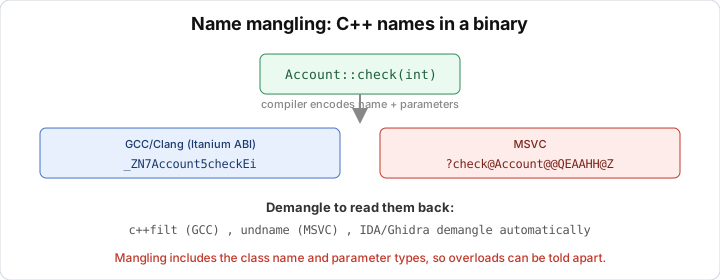
Nobody decodes mangling by eye. With c++filt, which ships with GCC, echo _ZN7Counter3addEi | c++filt gives Counter::add(int), and you can pipe the whole nm output through it to demangle in bulk. MSVC ships undname, which does the same for names of the ?... kind. IDA and Ghidra demangle automatically, so IDA shows Counter::add(int) in the function list. If you see names still mangled, check the demangling setting in the options.
For a reverser, name mangling helps. A C++ binary that still has symbols gives you the class names, method names, and parameter types, far more info than C. Only when the symbols are stripped do you lose this and have to infer from structure.
The this pointer
This is the second big difference. When you write c.add(5), it looks like one parameter. But the method needs to know which object it’s working on (which c), so the compiler passes the object’s address as the first parameter. That’s the this pointer.
On Linux/SysV, this is in rdi (the first parameter) and the real parameters shift down to rsi, rdx…. On Windows x64, this is in rcx and the real parameters shift down to rdx, r8….
This is the asm of c.add(5) on Linux (g++, -O0), with the object c a local variable at [rbp-0xc]:
lea    rax, [rbp-0xc]      ; rax = address of object c
mov    esi, 0x5            ; real parameter n = 5 into rsi (second parameter)
mov    rdi, rax            ; this = &c into rdi (first parameter, hidden)
call   _ZN7Counter3addEi   ; call Counter::add(int)
In C++ it’s just c.add(5), but at the binary level it’s a function with two parameters, add(&c, 5). When the first parameter (rdi/rcx) of a call is a pointer to memory holding object data, it’s a method call, not a plain function.
In IDA/Ghidra pseudocode, if a function keeps using the first parameter as a1->field, a1 is almost certainly this. Rename it to this and assign the class type, and the pseudocode gets much tidier.
Telling a method call from a plain function
Combining the two things above lets you tell C++ from C. The clearest sign is mangled function names (_ZN... or ?...@@) in the function list. Beyond that, the call loads an object pointer into rdi/rcx before the call, and that pointer is reused to access fields by offset ([this+0], [this+4]). A constructor also runs right after memory is allocated for the object (on the stack or after new), usually as the first function to touch that memory.
When you see all three, stop thinking “standalone C function” and think in objects and ask what this is, what fields the class has and which method reads/writes which field. Lesson 4.2 goes on to vtables and inheritance, where C++ really differs from C.
Lab
The goal is to see how C++ mangles function names and where the this pointer gets passed. You’ll build a small class from counter.cpp, look at the mangled names in the binary, demangle them, and point out the this pointer in rdi/rcx in a method call. Build it with one of these:
1
2
3
g++ -O0 -g counter.cpp -o counter          # Linux
g++ -O0 counter.cpp -o counter.exe         # Windows MinGW
cl /EHsc /Od counter.cpp                   # Windows MSVC
First look at the mangled names. On Linux run nm counter | grep -i counter and write down the symbol names of the two add functions and of the constructor. Where do they differ? Then pipe the output through c++filt with nm counter | grep -i counter | c++filt, and compare with the original names in the source. Why do the two add functions need different names?
Then find the this pointer. Open the binary in IDA or Ghidra (or use objdump -d -M intel counter), find main and look at the code that calls c.add(5). Which argument is loaded into rdi (Linux) or rcx (Windows) just before the call, and what is that value? In the call c.add(1, 2), three things are loaded before the call, this and the two numbers. Which registers do they go into, and in what order?
If you have MSVC, build with it too and compare its ?...@@ style of mangled names with the _ZN... style of GCC, using undname to demangle. Two more questions to think about. If the binary is stripped of symbols, can you still demangle, and how would you tell which class a function is a method of? And if a function’s pseudocode is full of a1->field, what is a1 most likely to be?
Show solution
The results below come from a real build with g++ (-O0) on Linux x86-64. nm counter | grep -i counter prints:
1
2
3
4
5
_ZN7Counter3addEi      W
_ZN7Counter3addEii     W
_ZN7CounterC1Ei        W
_ZN7CounterC2Ei        W
_ZNK7Counter3getEv     W
Through c++filt:
1
2
3
4
5
_ZN7Counter3addEi    ->  Counter::add(int)
_ZN7Counter3addEii   ->  Counter::add(int, int)
_ZN7CounterC1Ei      ->  Counter::Counter(int)
_ZN7CounterC2Ei      ->  Counter::Counter(int)
_ZNK7Counter3getEv   ->  Counter::get() const
Decoding the Itanium rules (GCC/Clang) goes like this. _ZN opens a name that has a namespace or class, 7Counter is a name 7 characters long, Counter, and 3add is a method 3 characters long, add. E closes the list of nested names, and what follows are the parameter types, where i is int, ii is (int, int), v is void. _ZNK (with a K) means a const method, so get() const. The constructor appears twice, as C1 and C2 (complete object versus base object constructor), and both demangle to Counter::Counter(int).
The two add functions need different names because the linker only sees symbols, and add(int) and add(int, int) sharing the name add would collide. Mangling puts the parameter types into the name (Ei versus Eii), so they become two separate symbols. That’s how overloading works at the link level.
For the this pointer, the part of main that calls c.add(5), where the object c is a local variable at [rbp-0xc], looks like this:
lea    rax, [rbp-0xc]      ; rax = &c
mov    esi, 0x5            ; n = 5  -> rsi (second argument)
mov    rdi, rax            ; this = &c -> rdi (first, hidden argument)
call   _ZN7Counter3addEi
this (&c) is in rdi, and the real argument n=5 is pushed down to rsi. At the binary level add is a function of two arguments, add(this, n). The call c.add(1, 2) looks like:
lea    rax, [rbp-0xc]
mov    edx, 0x2           ; m = 2 -> rdx (third argument)
mov    esi, 0x1           ; n = 1 -> rsi (second argument)
mov    rdi, rax           ; this -> rdi (first argument)
call   _ZN7Counter3addEii
The SysV register order is rdi (this), rsi (n), rdx (m). On Windows x64 it would be rcx (this), rdx (n), r8 (m).
MSVC mangles the same method into this form:
1
?add@Counter@@QEAAXH@Z     ->  public: void __cdecl Counter::add(int)
You decode it with undname "?add@Counter@@QEAAXH@Z". The syntax is different but it carries the same information, which is class, method and parameter types. The this pointer on Win64 goes in rcx.
On the reflection questions, a stripped binary often still keeps the mangled names of exported functions or dynamic symbols, but internal static functions lose their names. Then you infer the class from structure, since functions that receive a pointer in rdi/rcx and then access the same set of offsets are working on one class, and grouping them lets you rebuild the class. If the pseudocode is full of a1->field, then a1 is almost certainly this. Rename it to this and assign the class type so IDA or Ghidra shows field names instead of offsets. As a final check, the program prints 18 (10 + 5 + 1 + 2 = 18), which matches the Counter logic.
Key takeaways
C++ at the binary level is C plus a few conventions. Name mangling puts class, method and parameter types into the symbol name to support overloading, with GCC/Clang using _ZN... and MSVC using ?...@@. Don’t decode it by hand, use c++filt, undname, or let IDA/Ghidra demangle automatically. C++ symbols help you because they give class, method and parameter names, more than C does.
Every method has a hidden parameter this, in rdi on Linux and rcx on Windows x64. A call that loads an object pointer into rdi/rcx and then accesses fields by offset is a method call.
Previous: Part 3 C · Back to index · Next: 4.2 Classes, vtables, inheritance, RTTI